
 Contact
 How to shop

Delivery
Shopping guide
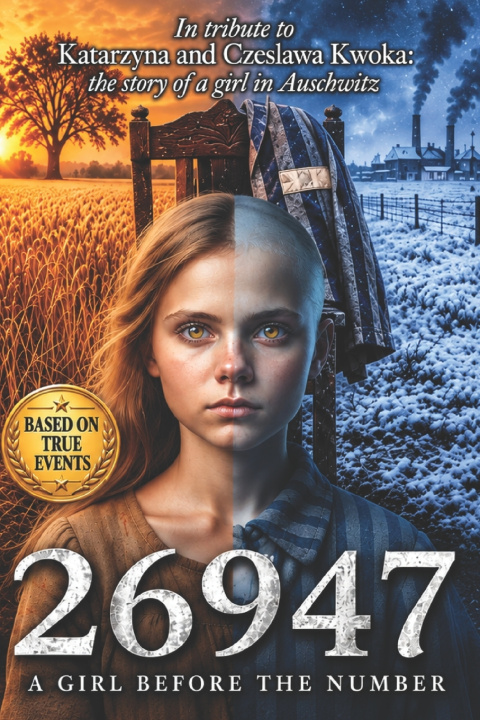
26947 - The Girl Before the Number
The story of a girl in Auschwitz-Birkenau - In memory of Katarzyna Kwoka and Czesława Kwoka
 English
 39 b
 Coming soon
 New
Up to 30 days for returns

She was fourteen years old when she was struck in the face for not understanding an order in German. With a cut lip and eyes full of tears, she tried to wipe away the blood before being photographed. Less than three months later, she would be dead.
Her name was Czesława Kwoka. And before she was number 26947, she was a girl who ran barefoot through golden wheat fields, made wishes under a linden tree, and woke up to the smell of bread baking in her mother's clay oven.
THE LIFE THAT EXISTED BEFORE THE PHOTOGRAPHYHer face appears in one of the most moving and recognized portraits of Holocaust memory, taken by prisoner Wilhelm Brasse at the Auschwitz-Birkenau camp. But almost no one knows the story behind her gaze: childhood in the Polish village of Wólka Złojecka, in the Zamość region; her widowed mother, Katarzyna, who raised her daughter alone; and the simple home where an empty chair stood, which no one ever occupied.
This historical novel, narrated in first person, delivers to the reader the entire life that the photograph does not show. The simple happiness of the countryside. The German occupation of Poland, hunger, fear, and the whispers of a looming war. The Nazi plan to expel thousands of Polish families to hand over their lands to German settlers. The knock on the door at dawn, fifteen minutes to leave everything behind, the house in flames.
FROM THE VILLAGE TO THE GATES OF AUSCHWITZMother and daughter were torn from their home, deported in cattle cars, and taken to Auschwitz-Birkenau in December 1942. There, they lost their hair, their clothes, and their names. They became numbers 26946 and 26947. They faced the extreme cold of the Polish winter, hunger, typhus, endless roll calls in the snow, the overcrowding of the barracks, and the daily struggle to stay alive, together, hand in hand.
In this book, you will follow the journey in the freight cars, the arrival at the concentration camp, the brutal process of dehumanization, the scene in the photographic studio, the most painful loss, and the final days of a teenager who refused to stop being who she was.
WHY THIS BOOK WILL STAY WITH YOUA true story told with emotion, free of sensationalism, where every smell, every object, and every promise matters. Accessible and engaging language, intense chapters, and a narrative that grips you from the first to the last page. A book to cry over, reflect on, and remember-for anyone moved by true stories of World War II, wanting to learn about the Polish victims of Nazism, and believing that memory is the best defense against hatred.
Ideal for those looking for books about the Holocaust, historical novels about World War II, true stories of Auschwitz, emotional historical fiction about occupied Poland, accounts of Nazi victims, and touching stories of mothers and daughters. Recommended for adult readers and young adults aged fourteen and up, history students and teachers, and reading groups.
A LITTLE-TOLD CHAPTER OF WORLD WAR IIThe story takes place in the Zamość region of occupied Poland, chosen by the Nazi regime for German colonization under the plan known as Generalplan Ost. More than one hundred thousand people, including about thirty thousand children, were expelled from their homes. This book gives that forgotten chapter a face, a voice, and a home: a novel about the love between mother and child, dignity in the face of barbarity, and the power of memory.
A TRIBUTEThis book is the first in the Before the Number series, which restores names and stories to the victims of the Holocaust. Every number was once a name. Remembering is a duty.
Historical fiction inspired by true events. Characters, dialogues, and intimate scenes were imagined from Auschwitz-Birkenau Museum records and historical accounts.
Read now and discover the girl who existed before the number.


About the book
English

Give this book today
It's easy
1 Add to cart and choose Deliver as present at the checkout 2 We'll send you a voucher 3 The book will arrive at the recipient's addressHi! I'm Libroamiko, your book advisor.
How can I help you?