
 Contact
 How to shop
Delivery
Shopping guide
 English
 38 b
38 b
 Coming soon
 New
New
Up to 30 days for returns

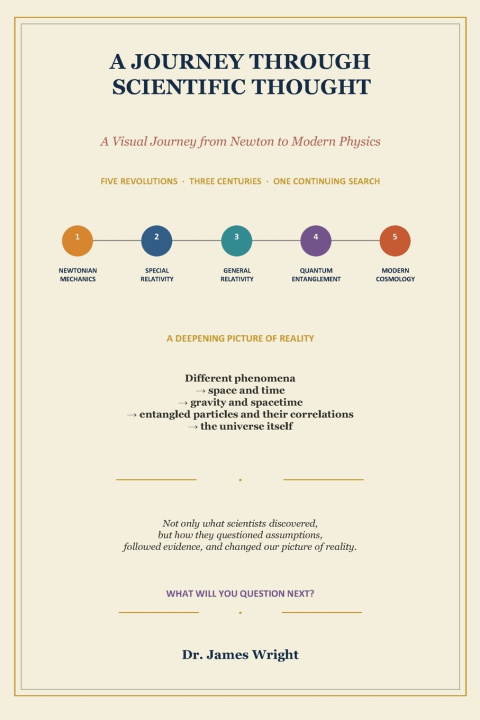
See the great revolutions of modern physics-and the scientific thinking behind them-at a glance.
This Full-Colour Infographic Edition explores how our understanding of nature has been transformed, from Newton's laws of motion and gravity to relativity, quantum entanglement, modern cosmology, and the continuing search for a deeper theory.
Rather than presenting physics as a long sequence of facts and equations, the book uses clear infographics, concise explanations, comparisons, and visual pathways to show not only what scientists discovered, but how new ways of thinking emerged when established ideas could no longer explain what nature revealed.
The journey begins with a simple question: Could the same law explain both a falling apple and the orbiting Moon? Newton brought the heavens and the Earth under the same universal laws. Einstein replaced absolute space and time with spacetime and transformed gravity from a force into spacetime geometry. Quantum entanglement challenged classical assumptions about separability and locality, while modern cosmology transformed the universe from a static background into a dynamic, evolving physical system.
These five revolutions-Newtonian mechanics, special relativity, general relativity, quantum entanglement, and modern cosmology-changed our picture of reality. Yet they also reveal something deeper: despite addressing very different questions, scientific revolutions often develop through a recurring eight-stage pattern of scientific thinking:
Observe Nature → Detect the Problem → Question Assumptions → Build a New Model → Derive Predictions → Let Nature Decide → Build a New Worldview → Discover New Limits
This pattern is not a straight path with a final ending. Discover New Limits is both the final stage of one revolution and the bridge to the next. A new theory may solve an old problem and transform our worldview, but its limits eventually reveal new problems, challenge new assumptions, and begin another cycle of scientific thought.
In this way, the revolutions of physics form a continuing journey:
New Questions → New Ideas → New Theories → New Evidence → New Worldviews → New Limits → New Questions
The deeper message is that science advances when we recognize the limits of even our most reasonable assumptions. Familiar phenomena can conceal profound questions, evidence can expose the limits of established ideas, and imagination can open new ways of understanding reality. But ultimately, nature must decide through observation and experiment.
Designed for students, general readers, teachers, and anyone curious about how science works, this infographic edition makes complex ideas easier to see, compare, connect, and remember. It invites readers not simply to learn the conclusions of modern physics, but to follow the changing patterns of thought that produced them.
From a falling apple to curved spacetime, from entangled particles to an expanding universe, every breakthrough changes what we understand-and reveals what we still do not know.
The journey does not end with a final answer; every answer leads to new questions. What new observations, experiments, and ideas will reveal the limits of our current theories and open the way to the next breakthrough in our understanding of the universe?


About the book
English
Categories

Give this book today
It's easy
1 Add to cart and choose Deliver as present at the checkout 2 We'll send you a voucher 3 The book will arrive at the recipient's addressHi! I'm Libroamiko, your book advisor.
How can I help you?