
 Contact
 How to shop
Delivery
Shopping guide
 English
 45 b
45 b
 New
New
Up to 30 days for returns

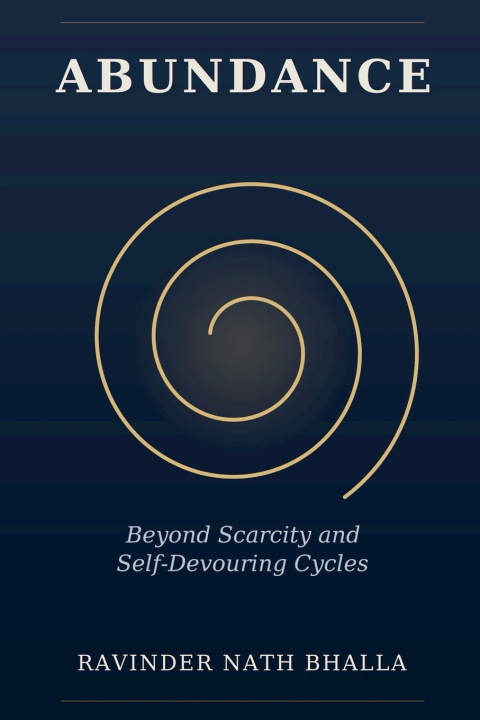
Why do the most powerful institutions repeatedly make decisions that produce
less security, not more? Why do we build systems that cost more and work worse
than alternatives we know about? Why does extraordinary intelligence so often
serve self-defeating cycles?
For forty years, psychiatrist Ravinder Bhalla has watched individuals and
institutions repeat patterns that harm them despite overwhelming evidence of
better alternatives. In ABUNDANCE, he reveals that our major crises-climate
change, mass incarceration, perpetual war, extreme inequality, political
polarization-are not separate problems but manifestations of one pattern:
scarcity thinking creating self-devouring cycles.
The evidence is clear: punishment creates more crime, not less. Extraction
accelerates climate instability. Accumulation compounds inequality. Walls
manufacture the threats they claim to prevent. Each "solution" perpetuates
the problem it claims to solve, consuming everyone it touches-including those
who think they benefit.
The abundance alternative exists and works. The Marshall Plan turned enemies
into partners. Norway's rehabilitation-based justice achieves 20% recidivism
versus America's 60%. Portugal's drug decriminalization reduced addiction and
death. The Montreal Protocol healed the ozone layer. In each case, investing
in root causes cost less and produced better outcomes than managing symptoms
indefinitely.
Yet we rarely choose abundance. Drawing on Nietzsche, clinical observation,
and systems analysis, Bhalla shows why: leaders who haven't genuinely faced
their own mortality cannot think in generations. They optimize for quarterly
returns, electoral cycles, and personal accumulation-even when those choices
destroy the foundations they depend on.
Written at the exact moment when AI deployment decisions will determine whether
technology amplifies human capacity or eliminates human agency, ABUNDANCE offers
both rigorous diagnosis and practical framework. The book examines the hardest
test case-Israeli-Palestinian conflict-proving that if abundance thinking can
work there, objections elsewhere are exposed as insufficient. It then addresses
AI as the ultimate fork: the same capability that could enable surveillance and
mass unemployment could instead strengthen democracy and address the "lowest-
hanging fruit"-Haiti, extreme poverty, water scarcity-that we've abandoned
despite having resources to transform conditions for hundreds of millions.
The scarcity trajectory is the path of least resistance. The abundance
trajectory requires psychological work most leaders haven't done: facing
mortality, examining inherited values, recognizing wholeness, channeling will
to power toward creation rather than domination.
This is not idealism. It is arithmetic backed by historical precedent. The
question is whether enough people with enough power will choose it before the
window closes.
For readers of Yuval Noah Harari, Atul Gawande, and Daniel Kahneman who want
to understand why we're trapped-and what psychological transformation would
make different choices possible.
ABUNDANCE is an invitation to remember what we've forgotten: that we were born
into abundance, life itself is abundance, and the cycles consuming us are not
the price of being human but the cost of forgetting what we are.


About the book
English

Give this book today
It's easy
1 Add to cart and choose Deliver as present at the checkout 2 We'll send you a voucher 3 The book will arrive at the recipient's addressHi! I'm Libroamiko, your book advisor.
How can I help you?