
 Contact
 How to shop

Delivery
Shopping guide
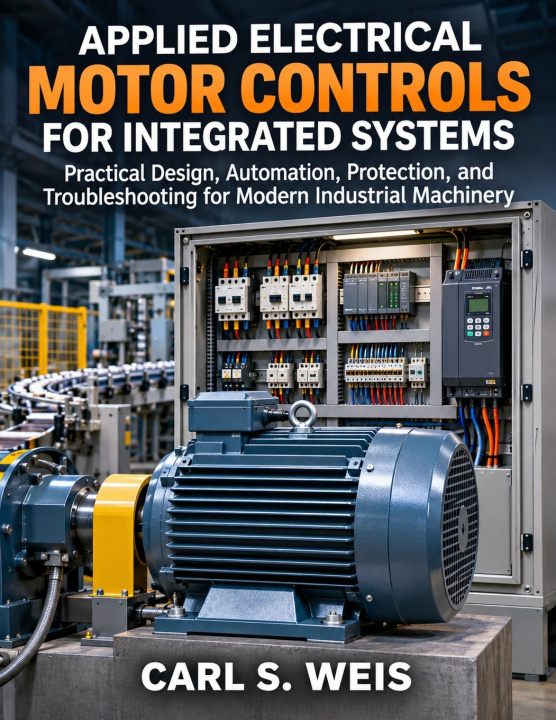
Applied Electrical Motor Controls for Integrated Systems
Practical Design, Automation, Protection, and Troubleshooting for Modern Industrial Machinery
 English
 266 b
 Coming soon
 New
Up to 30 days for returns

Electric motors are at the heart of modern industrial machinery-but making a motor run is only the beginning. Reliable motor-driven systems must coordinate electrical power, protection, control logic, sensors, drives, operator interfaces, communications, safety functions, and the mechanical process as one integrated system.
For students, technicians, electricians, and engineers, the challenge is often connecting these individual technologies. Knowing how a contactor, PLC, VFD, overload relay, sensor, or motor works independently does not automatically explain how to select, coordinate, commission, and troubleshoot them within a complete machine. Poorly coordinated control decisions can lead to nuisance trips, unreliable operation, difficult diagnostics, unnecessary mechanical stress, and unsafe assumptions about equipment state.
Applied Electrical Motor Controls for Integrated Systems bridges the gap between fundamental motor-control instruction and the integrated systems encountered in manufacturing, material handling, pumping, ventilation, processing, packaging, and automated machinery. With an applied engineering approach, it develops the reasoning needed to move from process requirements to practical control architectures while keeping protection, safety, reliability, maintainability, and operating behavior in view.
Inside, readers will learn how to:
- Understand motor characteristics, torque-speed behavior, load requirements, duty cycles, and motor selection.
- Read power and control drawings and develop practical relay, contactor, starter, interlocking, reversing, jogging, braking, and sequencing circuits.
- Apply motor-circuit protection principles, including overload protection, short-circuit and ground-fault protection, disconnecting means, grounding, bonding, and SCCR considerations.
- Develop PLC-based motor control using digital and analog I/O, ladder logic, permissives, interlocks, timers, counters, sequences, and diagnostics.
- Understand VFDs, soft starters, reduced-voltage starting, servo systems, stepper systems, feedback, and precision motion control.
- Integrate motor control centers, industrial control panels, HMIs, industrial networks, remote I/O, connected drives, and supervisory systems.
- Approach electrical safety, functional safety, commissioning, troubleshooting, preventive maintenance, root-cause analysis, and system verification systematically.
Designed for upper-level engineering and engineering-technology students, industrial electricians and technicians advancing into controls work, controls specialists, and practicing engineers, this book can be studied sequentially as a course or used selectively as a technical reference.
Add Applied Electrical Motor Controls for Integrated Systems to your technical library and develop a more connected understanding of how motor-driven machinery is powered, commanded, protected, automated, made safe, commissioned, diagnosed, maintained, and improved.


About the book
English

Give this book today
It's easy
1 Add to cart and choose Deliver as present at the checkout 2 We'll send you a voucher 3 The book will arrive at the recipient's addressHi! I'm Libroamiko, your book advisor.
How can I help you?