
 Contact
 How to shop
Delivery
Shopping guide
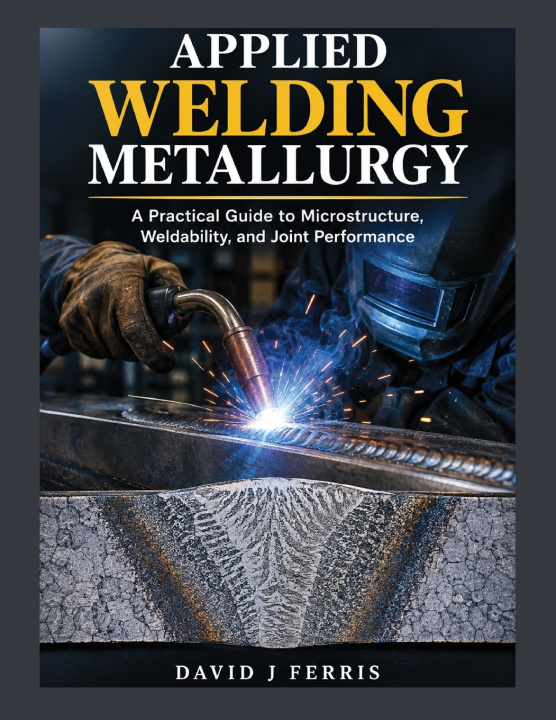
Applied Welding Metallurgy
A Practical Guide to Microstructure, Weldability and Joint Performance
 English
 252 b
252 b
 Coming soon
 New
New
Up to 30 days for returns

A weld can look flawless and still fail years later.
The appearance of a weld bead says little about the microstructure that formed as the metal was heated, melted and cooled within seconds, yet that microstructure decides whether a joint performs or cracks. Procedure tables help until a project falls outside them or a joint fails unexpectedly. Then understanding matters more than memorization.
What this book gives you
It explains the metallurgy behind the weld in a clear progression, from iron and steel transformations through heat flow, the heat-affected zone and the defect mechanisms behind most structural weld failures. Each chapter develops theory from first principles, then puts it to work in worked examples and practice problems with worked answers.
What you will be able to do
- Understand how welding thermal cycles create a localized, nonuniform heat treatment
- Relate heat-affected zone microstructure to hardness, strength and toughness
- Apply carbon equivalent and preheat reasoning to the weldability of hardenable steels
- Tell hydrogen cracking, hot cracking and lamellar tearing apart by mechanism
- Compare the weldability concerns of carbon, low-alloy and stainless steels and of aluminum and other nonferrous alloys
- Weigh filler metal selection, dilution and weld metal microstructure
- Match mechanical tests and nondestructive examination methods to the defects they can reveal
Fourteen chapters move from crystal structure, phase diagrams and thermal cycles to alloy-specific weldability, crack mechanisms, qualification, testing and examination, and close with original failure-analysis case scenarios that draw on every earlier chapter. Appendices provide carbon equivalent and hardenability formulas and hardness and mechanical property tables. SI units are used throughout, with United States customary equivalents in parentheses.
Who it is for
Welding engineers, welding technologists, inspectors, metallurgists and students, whether they are meeting these ideas for the first time or returning to the metallurgy behind a familiar procedure. Readers who already know basic physical metallurgy can begin at the heat-flow chapter and use the earlier chapters for review.
This is an educational text. It does not replace the governing codes, standards and specifications for a project, or qualified engineering review.
Open Applied Welding Metallurgy and begin building the understanding to read a welded joint from the microstructure outward.


About the book
English

Give this book today
It's easy
1 Add to cart and choose Deliver as present at the checkout 2 We'll send you a voucher 3 The book will arrive at the recipient's addressHi! I'm Libroamiko, your book advisor.
How can I help you?