
 Contact
 How to shop

Delivery
Shopping guide
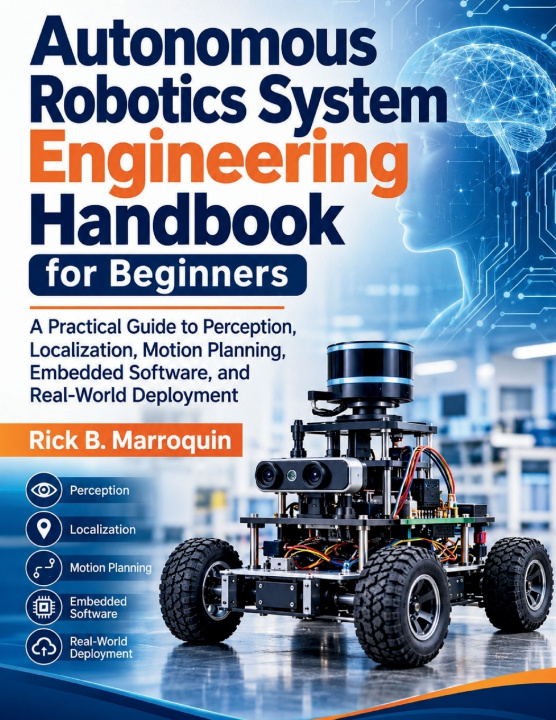
Autonomous Robotics System Engineering Handbook for Beginners
A Practical Guide to Perception, Localization, Motion Planning, Embedded Software, and Real-World Deployment
 English
 106 b
 Coming soon
 New
Up to 30 days for returns

Can a robot understand what it sees, determine where it is, choose a safe path, and act reliably in the physical world? Building a system that can do all four is a central challenge of autonomous robotics engineering. Perception, localization, planning, embedded software, and deployment must work together.
The Autonomous Robotics System Engineering Handbook for Beginners introduces the ideas and engineering decisions behind robots that operate independently. Rather than treating each technology as an isolated subject, it shows how information moves through an autonomous robotic system-from sensing the environment to estimating position, selecting movement, and carrying out actions.
How does a robot interpret sensor data? What allows it to estimate its location when the environment changes? How can it plan motion while accounting for obstacles and real-world demands? Explore the foundations of robotic perception, localization, and motion planning, while understanding the role each plays in autonomous decision-making.
Autonomy also depends on the software and hardware beneath a robot's behavior. This guide introduces embedded software as a vital part of system engineering and explains its role in coordinating functions. It also considers real-world deployment, where a design must face practical conditions beyond an ideal demonstration. By connecting core concepts with implementation, the book encourages you to think like an engineer: consider the whole system, recognize dependencies, and evaluate how design choices affect performance.
Whether you are a student exploring robotics, a beginner developing technical knowledge, or an aspiring engineer seeking a structured introduction, this book can help you approach the subject with confidence. It is relevant to readers interested in autonomous robots, robotics system design, mobile robotics, robotic navigation, embedded systems, and intelligent machines.
Inside, you will develop a connected understanding of:
How robotic perception helps a machine interpret its surroundings
Why localization is essential for reliable navigation
How motion planning guides movement through an environment
Where embedded software fits into autonomous system behavior
What real-world deployment asks of an engineered robotic system
A capable autonomous robot is not one clever component; it is a coordinated system. Discover the engineering principles that bring its parts together, strengthen your technical foundation, and take an informed first step into autonomous robotics. Add the Autonomous Robotics System Engineering Handbook for Beginners to your library and begin exploring how intelligent machines sense, navigate, plan, and operate in the real world.


About the book
English

Give this book today
It's easy
1 Add to cart and choose Deliver as present at the checkout 2 We'll send you a voucher 3 The book will arrive at the recipient's addressHi! I'm Libroamiko, your book advisor.
How can I help you?