
 Contact
 How to shop

Delivery
Shopping guide
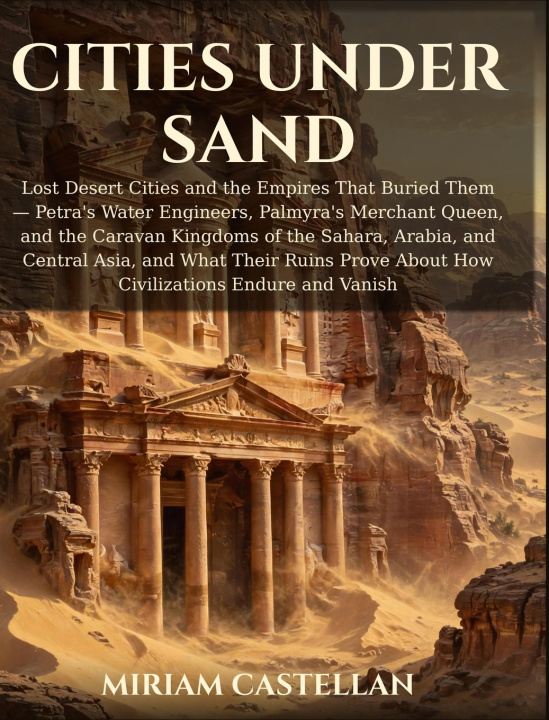
Cities Under Sand
Lost Desert Cities and the Empires That Buried Them - Petra's Water Engineers, Palmyra's Merchant Queen, and the Caravan Kingdoms of the Sahara, Arabia, and Central Asia, and What Their Ruins Prove About How Civilizations Endure and Van
 English
 112 b
 New
Up to 30 days for returns

Forty cities rose in the driest places on Earth. Every one of them had water, wealth, and walls. None of that was enough. Petra bloomed in a canyon with almost no rain. Palmyra taxed the caravans of two empires from an oasis in the Syrian desert. Merv ringed itself with walls and canals on the edge of the Karakum - and in 1221 met the most famous catastrophe in Silk Road history. Cities Under Sand tells each city's whole life in one chapter: how it solved water, what moved through its gates, who got rich, which of the three supports - water, route, or political order - failed first, and what the ruins actually prove today. This is honest history. The evidence is named. The legends are labelled as legends. The famous ports and sunken cities whose sites are still debated - Gerrha, Ubar - are presented as debated, because what the record can and cannot prove is the most interesting part of the story. Inside you'll discover: How Petra's engineers harvested flash floods with dams, channels, and cisterns - and why the system outlived the kingdom. The frankincense road: Marib's great dam, Shabwa, and Timna, where perfume for temples built desert capitals. Palmyra's caravan tariffs, merchant queen, and the Aurelian destruction - with the Zenobia legends separated from the sources. The Sahara's gold cities: Garama's underground water tunnels, Sijilmasa, Kumbi Saleh, and Timbuktu's unmaking when trade moved to the sea. The Silk Road deserts: Merv, Penjikent's painted rooms, Jiaohe carved into a cliff island, and Loulan beside its vanishing lake. Why cities really die - the three failures, water, route, and order, tested against forty case histories. Who this book is for: Readers of popular ancient history who want the whole life of a city, not a mystery-mongering tour; armchair travellers of the Sahara, Arabia, and Central Asia; and anyone who has ever stood in a ruin and wondered what it took to build there - and what it took to leave. Miriam Castellan writes narrative history about the ancient world's working systems - water, roads, and the people who maintained them.


About the book
English

Give this book today
It's easy
1 Add to cart and choose Deliver as present at the checkout 2 We'll send you a voucher 3 The book will arrive at the recipient's addressHi! I'm Libroamiko, your book advisor.
How can I help you?