
 Contact
 How to shop

Delivery
Shopping guide
 English
 79 b
 New
Up to 30 days for returns

One invisible particle. One corrupted bit. One system that can no longer be trusted.
A computer can produce the wrong answer without a software bug, a broken circuit, or any visible damage.
A high-energy particle crosses a semiconductor. A tiny electrical charge is deposited. A zero becomes a one. The machine keeps running-but its data, calculations, or control decisions may already be compromised.
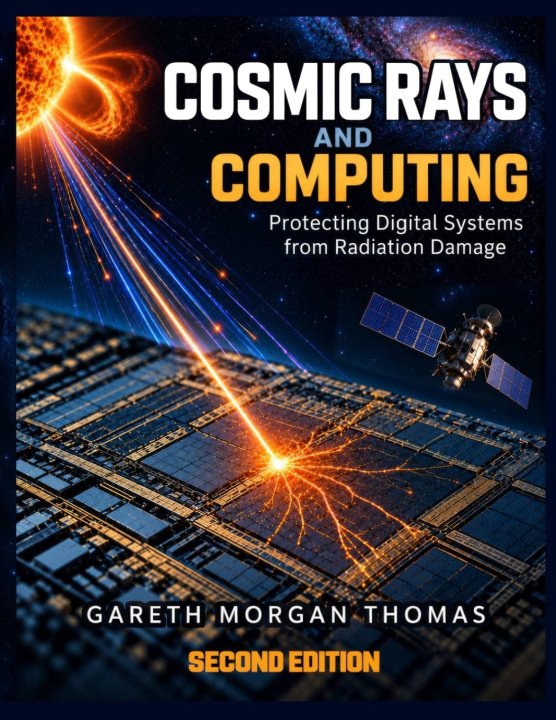
This is the extraordinary engineering problem at the heart of Cosmic Rays and Computing.
From terrestrial computers to high-altitude aircraft and spacecraft, radiation-induced faults create challenges that ordinary electrical specifications cannot solve. Protecting digital systems requires more than robust components. It requires understanding exactly how particles produce faults-and how those faults can be detected, corrected, contained, and recovered from.
The Science Behind the Failure. The Engineering Behind the Solution.In this expanded Second Edition, Gareth Morgan Thomas connects particle physics, semiconductor technology, digital architecture, and fault-tolerant computing in one comprehensive technical guide.
You will explore:
Cosmic rays and energetic particles - Their origins, atmospheric interactions, and the distinct hazards of terrestrial, aviation, and space environments.
Single-event upsets (SEUs) - How deposited charge triggers bit flips, corrupts memory, and propagates through digital logic.
Semiconductor vulnerability - Critical charge, single-event transients, latchup, multiple-cell upsets, and total ionizing dose.
Nuclear radiation and EMP - How prompt radiation, neutrons, gamma rays, and electromagnetic pulses threaten electronic systems.
Radiation-hardened hardware - Design techniques, manufacturing approaches, and the performance and cost trade-offs of resilient components.
Error detection and correction - ECC, Hamming codes, Reed-Solomon encoding, checksums, and CRCs.
Real-time fault mitigation - Triple modular redundancy, majority voting, built-in self-test, and memory scrubbing.
Software fault tolerance - Error monitoring, resilient algorithms, system recovery, and architectures designed to preserve data integrity.
Radiation-resilient FPGAs - Configuration faults, redundancy, dynamic reconfiguration, and scrubbing.
Secure computing and physical randomness - Entropy sources, environmental noise, and random-number generation.
Emerging technologies - AI-assisted fault prediction and future directions in resilient semiconductor and computing design.
A radiation-induced fault is not necessarily a hardware failure. The component may survive while the information it processes becomes wrong.
That distinction changes everything.
This book follows the entire chain: radiation environment, particle interaction, charge collection, circuit response, corrupted logic, and system-level consequences. It then examines the protective methods engineers use to interrupt that chain.
The emphasis is on engineering understanding: mechanisms, mathematical models, practical design principles, and the limitations and trade-offs of different defenses.
The Universe Does Not Need to Break a Computer to Make It Wrong.Discover how invisible particles threaten digital systems-and how intelligent engineering makes those systems more resilient.
Get your copy of Cosmic Rays and Computing, Second Edition today.


About the book
English

Give this book today
It's easy
1 Add to cart and choose Deliver as present at the checkout 2 We'll send you a voucher 3 The book will arrive at the recipient's addressHi! I'm Libroamiko, your book advisor.
How can I help you?