
 Contact
 How to shop
Delivery
Shopping guide
Engineering Atmospheric Carbon Removal
Volume-I: Fundamentals of Atmospheric CO₂ Capture
 English
 112 b
112 b
 New
New
Up to 30 days for returns

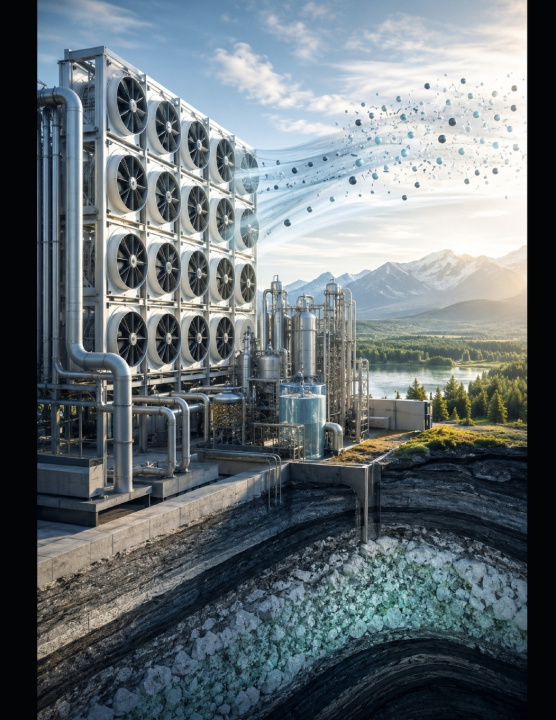
Every year, humanity releases tens of billions of tonnes of carbon dioxide into the atmosphere. Removing that carbon is no longer a scientific curiosity-it is rapidly becoming one of the defining engineering challenges of the twenty-first century.
Engineering Atmospheric Carbon Removal: Volume I provides a rigorous, systems-level introduction to the science and engineering of removing CO₂ directly from ambient air. Rather than treating Direct Air Capture (DAC) as a collection of isolated technologies, this volume develops the subject from first principles, connecting thermodynamics, adsorption science, transport phenomena, and process engineering into a unified framework for understanding atmospheric carbon removal.
Beginning with the global carbon cycle and the thermodynamic limits of gas separation, the book explores why extracting CO₂ from air is fundamentally different from conventional industrial separations. Readers are guided through adsorption equilibria, sorbent materials, molecular interactions, kinetics, diffusion, pressure drop, and engineering trade-offs that govern the design of high-performance capture systems. Complex concepts are explained through engineering intuition before progressing to mathematical formulation and practical application.
Unlike books that focus only on materials or only on process design, this volume integrates physics, chemistry, and engineering into a coherent learning pathway. Every chapter is designed to connect fundamental scientific principles with the realities of industrial implementation, enabling readers to understand not only how Direct Air Capture systems work, but why they behave the way they do.
This first volume establishes the scientific foundation for the trilogy. Subsequent volumes expand into process engineering, thermal integration, regeneration technologies, CO₂ conditioning, mineralization, geological storage, life-cycle assessment, and gigaton-scale deployment.
Inside this volume, you'll discover:- The engineering principles governing atmospheric CO₂ capture.
- The thermodynamic limits of separating dilute carbon dioxide from air.
- Adsorption science, sorbent materials, and equilibrium behavior.
- Heat and mass transfer fundamentals for Direct Air Capture systems.
- The engineering trade-offs that determine system efficiency and scalability.
- A structured progression from scientific principles to engineering practice.
Whether you are a graduate student, researcher, practicing engineer, energy professional, or scientist entering the field of carbon removal, this book provides a technically rigorous and practical foundation for understanding one of the fastest-evolving disciplines in modern engineering.
From atmospheric molecule to engineered system, this volume explains the science behind permanent carbon removal-one principle at a time.


About the book
English
