
 Contact
 How to shop
Delivery
Shopping guide
ENGINEERING MECHANICS
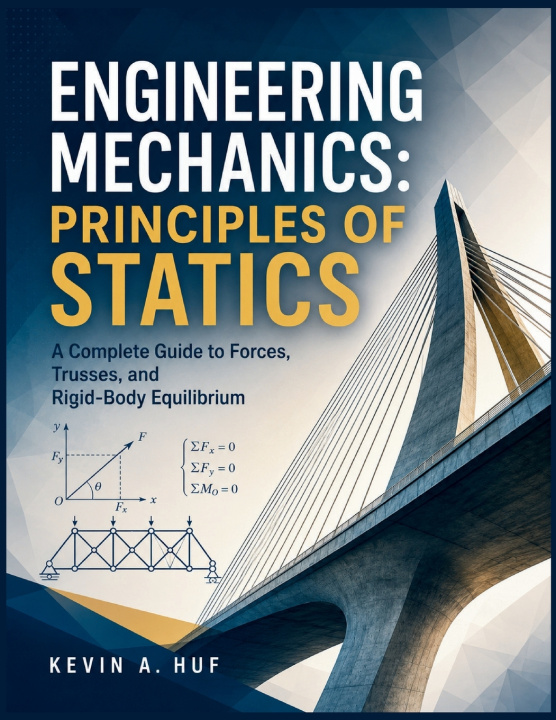
PRINCIPLES OF STATICS: A Complete Guide to Forces, Trusses, and Rigid-Body Equilibrium
 English
 199 b
199 b
 Coming soon
 New
New
Up to 30 days for returns

A single sign error in one free-body diagram can turn a correct equilibrium equation into a wrong answer on every line that follows it, and it is exactly the kind of mistake that a rushed textbook lets slip through unexplained.
Most engineering students meet the same wall. A first course in statics moves quickly from a single particle in equilibrium to full rigid bodies, trusses, frames, and beams, and many textbooks skip the derivation step that would make that jump make sense. Worked examples stop short of showing exactly where a real calculation goes wrong, answer keys give a final number without explaining the misstep that would have produced a different one, and working in two unit systems side by side, SI and US Customary, adds one more place for a small error to hide.
This book was written as a single, self-contained treatment of statics that proceeds in a fixed order, from vector fundamentals through particle and rigid-body equilibrium, structural analysis, internal forces, centroids and moments of inertia, friction, energy methods, and cables, building every equation from stated assumptions and working every numerical answer in full, with units tracked from the first line to the last.
Inside, you will:
- Follow the complete derivation behind every equilibrium equation, moment relationship, and structural method, rather than being handed a formula to memorize.
- Apply the method of joints and the method of sections to determine which truss members carry load and which are zero-force members, and analyze frames and machines by the dismemberment method.
- Construct shear and bending-moment diagrams for beams, determine centroids and centers of gravity for composite shapes, and calculate moments and products of inertia and radius of gyration.
- Work through dry friction in wedges, square-threaded screws, belts, and disk or collar contacts, and model cables under concentrated loads, as a parabola, and as a true catenary.
- Recognize the specific misconceptions that produce sign errors, mislabeled supports, and unit mismatches, through dedicated 'common errors' sections placed exactly where those mistakes happen.
- Build confidence with numbered worked examples, practice problems, and a boxed answer key at the end of every chapter, so you can check your own work honestly before moving on.
- Move comfortably between SI and US Customary units throughout, and use a complete list of symbols, glossary, index, and appendices as an ongoing reference.
Who this book is for: This book is written for undergraduate engineering students taking a first course in statics, for instructors seeking a structured supplementary text, and for practicing engineers and technicians who want a rigorous, self-contained reference covering the full breadth of the subject, from a single free-body diagram to a fully catenary cable.
Get your copy and discover a structured approach to the derivations, methods, and applications covered inside, built around the habits that determine whether a statics equation comes out right.


About the book
English

Give this book today
It's easy
1 Add to cart and choose Deliver as present at the checkout 2 We'll send you a voucher 3 The book will arrive at the recipient's addressHi! I'm Libroamiko, your book advisor.
How can I help you?