
 Contact
 How to shop

Delivery
Shopping guide
 English
 59 b
 New
Up to 30 days for returns

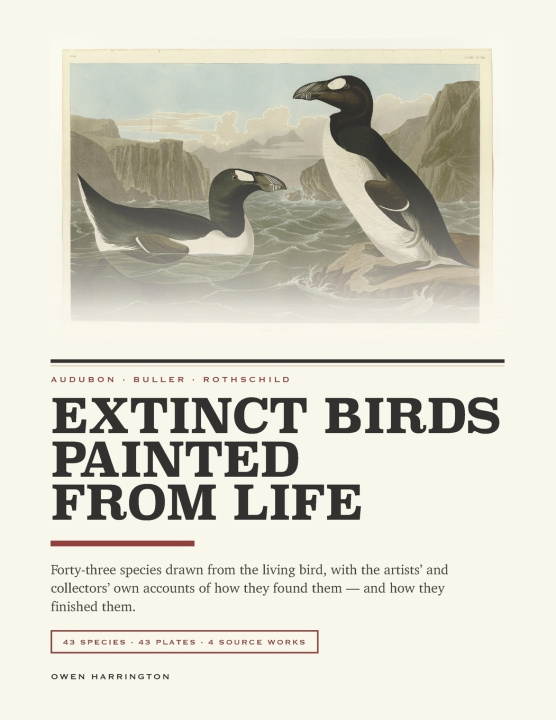
Every bird in this book was drawn by someone who had the animal in front of them.
That is a narrower rule than it sounds. Most pictures of extinct animals are reconstructions - somebody measured a skeleton, read a sailor's description, and painted what the creature probably looked like. The dodo appears here only as an argument, because nobody we can trust ever drew one alive.
The forty-three birds were painted from the bird itself: usually one shot that morning, occasionally one still alive in a cage, once from birds held in a crate in Honolulu harbour. Forty-three full-page colour plates, each facing a page about the bird and the man who drew it.
From Audubon's Birds of America: the great auk, the passenger pigeon, the Carolina parakeet, the Labrador duck, the ivory-billed woodpecker. From Buller's Birds of New Zealand: the huia, the laughing owl, the piopio, the takahē. From Rothschild and Wilson on Hawaii: the mamo, all four ʻōʻō, the kioea, the koa finches - the most comprehensively destroyed bird fauna in the world.
The text quotes the collectors directly. Audubon counting pigeon flocks with a pencil until the task defeated him. Buller writing the standard work on New Zealand's birds while selling their skins to London. Henry Palmer buying the last Laysan rails from a sea captain because no steamer was leaving for Europe.
Every quotation is verbatim from a public-domain source published between 1827 and 1900.
Note: the dodo is discussed, not pictured. The text was written with the assistance of artificial intelligence and edited by the author.


About the book
English

Give this book today
It's easy
1 Add to cart and choose Deliver as present at the checkout 2 We'll send you a voucher 3 The book will arrive at the recipient's addressHi! I'm Libroamiko, your book advisor.
How can I help you?