
 Contact
 How to shop

Delivery
Shopping guide
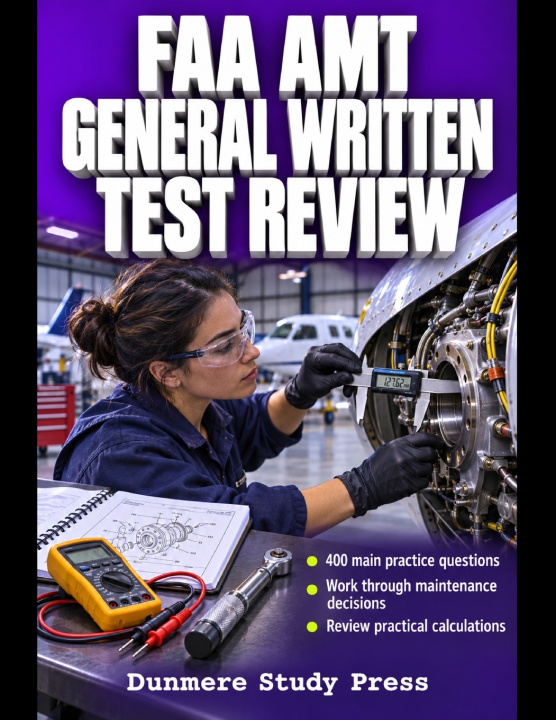
FAA AMT General Written Test Review
ACS-Guided Maintenance Decisions, Worked Calculations, and Five Rationale-Based Practice Tests
 English
 115 b
 New
Up to 30 days for returns

Your AMT General written test, as a checklist
Tick each box in order, and the General test stops feeling like twelve separate subjects. Work them in sequence, and never skip the box you dislike.
Box 1. Map the test before you study it
Chapter 1 shows how ACS codes tie the AMT General written test to subjects A through L. One code, such as AM.I.C.K4, points to a single knowledge element. You separate three kinds of authority: the regulation, the aircraft data, and the ACS itself. You learn what an Airman Knowledge Test Report can and cannot tell you. A readiness check gives you three questions to ask before any maintenance decision.
Box 2. Build the workbench habit
Chapter 2 teaches five moves: name the task, mark the facts, choose the source, solve first, then challenge. Worked checks cover Ohm's law, a two-load center of gravity, unit conversions, and pressure. One setup puts 18,400 pound-inches over 200 pounds for a CG of 92 inches. A conversion check turns 2.5 inches into 63.5 millimeters.
Box 3. Sit five staged tests
Each of the five tests holds 80 original four-option items, all tagged to ACS knowledge codes. Time checks fall after Q20, Q40, and Q60, and no scoring happens before Q80.
- General Foundations
- Processes and Interpretation
- Aircraft Maintenance Applications
- Exceptions and Close Distinctions
- Integrated General Capstone
Box 4. Score by subject and by cause
Every answer gets a full rationale, and each wrong option gets its own reason for failing. Each rationale ends with a rule worth memorizing, the usual trap, and what to watch for. A domain dashboard then shows your result over the real count in all twelve subjects. Five cause labels, FACT, SETUP, SOURCE, CONDITION, and READING, turn a miss into a repair. Correct CG math never checked against the approved range is a CONDITION error.
Box 5. Retake with changed facts
Ten retakes follow each test, so the book carries 400 counted items plus 50 retakes. A retake keeps the skill but changes the case, so recalling an old letter earns nothing. One retake asks for 80 inch-pounds when the first wrench stops at 60. Appendix E then maps ten verified retake routes through the capstone test.
Box 6. Close gaps in the final days
Chapter 8 hands every weak skill a field sheet with a one-minute retrieval check. Two-check decision maps and five stop, check, and resume sequences rehearse safe holds. A final-day dashboard sends every red subject back to its governing FAA source.
Box 7. Keep the reference shelf open
The back matter holds a glossary with symbols and 26 formulas with worked setups. Memory aids cover each General subject, and a finder links topics to practice items. Annotated references include FAA-S-ACS-1, FAA-G-ACS-1, FAA-H-8083-30B, and the 14 CFR sections behind each rule.
Worried it is too much, or out of date?
Each box points back to a named FAA source, so you check a rule at its origin. Rules and handbooks change, so the book has you check current text before acting. A fourteen-day route suits experienced learners, while a thirty-day route rebuilds the basics.
Limits this review keeps
This review prepares you for the AMT General written test, yet it is not an FAA publication. The FAA does not endorse, sponsor, or approve it. Its practice items are original teaching cases, not recalled test questions. Nothing here authorizes aircraft work, and a book score never predicts your FAA result.
Tick the first box today
Write the letters A through L down one side of a sheet. Mark every subject where you cannot name its governing source, then open Chapter 1.


About the book
English

Give this book today
It's easy
1 Add to cart and choose Deliver as present at the checkout 2 We'll send you a voucher 3 The book will arrive at the recipient's addressHi! I'm Libroamiko, your book advisor.
How can I help you?