
 Contact
 How to shop
Delivery
Shopping guide
Fermentation
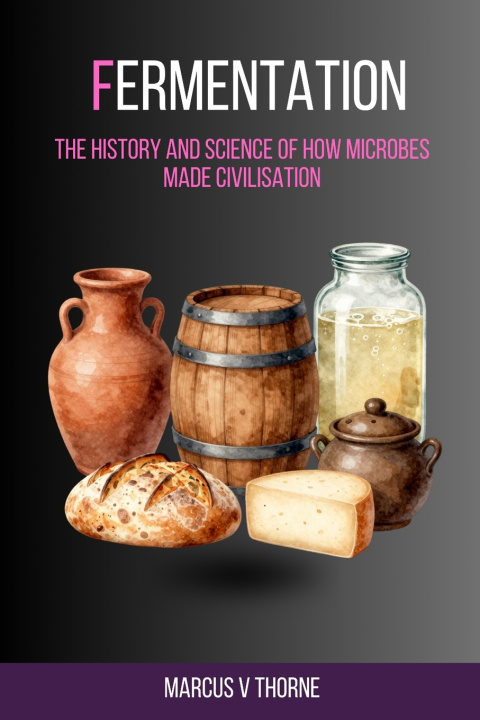
The History and Science of How Microbes Made Civilisation: A Curious Reader's Guide to Ancient Brewing, Pasteur's Revolution, Microbial Biochemistry, and the Fermentation Renaissance
 English
 47 b
47 b
 New
New
Up to 30 days for returns

Fermentation fed the first cities, defeated infectious disease, and may reshape the food supply again. This is its complete history and science.
Fermentation is among the oldest and most consequential of all human technologies. Before agriculture, there was probably fermentation: the discovery that crushed grains and fruits left in the right conditions would transform into something that kept longer, tasted different, and had effects on the body that could not be explained for five thousand years. Beer and bread in ancient Mesopotamia, wine across the Mediterranean world, miso and soy sauce in China and Japan, injera in Ethiopia, kefir in Central Asia, chicha in the Andes, tempeh in Indonesia: all of these are fermentation, and together they represent one of the most globally diverse and culturally embedded of all human food traditions. Yet what fermentation actually is, in the biochemical sense, was not understood until Louis Pasteur's work in the 1850s and 1860s demolished the theory of spontaneous generation and laid the foundations for germ theory, food science, and modern medicine.
This book tells the complete story of fermentation: the history and the science, interleaved throughout rather than separated into two different books. It covers the archaeological evidence for fermentation in prehistory; the role of fermented foods in sustaining the first cities; the global diversity of fermentation traditions across Asia, Africa, the Americas, and Europe; Pasteur's revolutionary proof that fermentation is microbial; the biochemistry of what happens when yeast converts glucose to ethanol and why lactic acid bacteria produce sour flavours instead; the industrial transformation of fermentation that gave us penicillin, vitamins, and biofuels alongside factory bread and mass-produced beer; the microbiome revolution and what the science actually supports about fermented foods and human health; and the craft fermentation revival and synthetic biology developments that are making fermentation one of the defining technologies of the present moment.
It is the book that popular writing on fermentation has been missing: one that takes the science as seriously as the history, treats the global diversity of traditions with the depth it deserves rather than treating sourdough and craft beer as the centre of the story, and is honest about where the commercial health claims about fermented foods outrun the published evidence. Whether you are a home fermenter, a food historian, a reader curious about the microbiome, or someone who wants to understand why these invisible organisms have shaped human civilisation more than almost anything else, this book is the account you have been looking for.
Written with the precision of good science writing and the narrative engagement of cultural and social history, this book treats fermentation as what it actually is: a phenomenon that operates at every scale from the metabolic pathway to the civilisation, and that is as important to understanding where human beings came from as it is to understanding where they are going. It is the single most comprehensive and intellectually honest account of fermentation history and science available to a general reader.


About the book
English

Give this book today
It's easy
1 Add to cart and choose Deliver as present at the checkout 2 We'll send you a voucher 3 The book will arrive at the recipient's addressHi! I'm Libroamiko, your book advisor.
How can I help you?