
 Contact
 How to shop
Delivery
Shopping guide
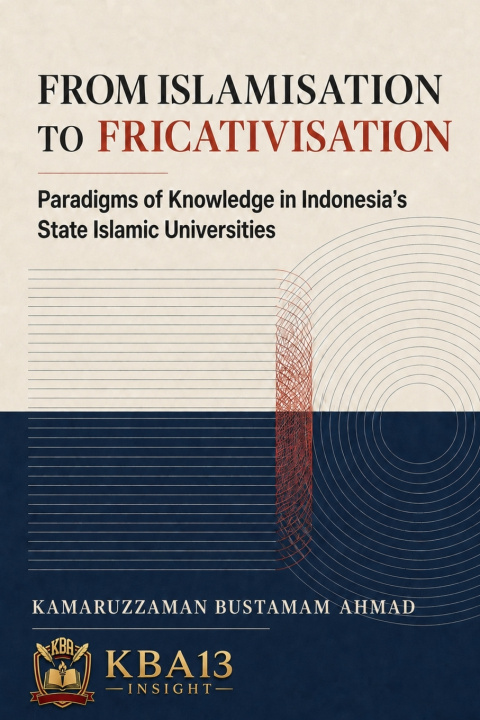
From Islamisation to Fricativisation
Paradigms of Knowledge in Indonesia's State Islamic Universities
 English
 59 b
59 b
 New
New
Up to 30 days for returns

What happens when an Islamic university brings revelation and modern science under one roof-yet never fully resolves how their different claims to knowledge should relate?
Indonesia's state Islamic universities have spent more than half a century confronting this question. Successive paradigms-Islamisation, integration, and interconnection-have attempted to reconcile the religious sciences with modern academic disciplines. Each has expanded the intellectual horizons of Islamic higher education. Yet the division between revealed and acquired knowledge continues to shape curricula, research methods, institutional structures, and academic life.
In From Islamisation to Fricativisation, Kamaruzzaman Bustamam Ahmad offers a critical intellectual history of these paradigms while introducing an original alternative: the fricativisation of knowledge.
Borrowing its central metaphor from phonetics, fricativisation understands knowledge as something produced through resistance. Just as a fricative sound emerges when breath passes through a constricted space, new knowledge may arise when different intellectual traditions are brought into disciplined tension-not prematurely harmonised, separated into parallel domains, or reduced to one another.
Drawing upon Islamic intellectual traditions, the experience of Indonesia's State Islamic Higher Education Institutions (PTKIN), and the author's perspective as both scholar and institutional insider, the book examines the deeper sources of their epistemological crisis. It addresses dependence on imported theoretical categories, the distance between institutional paradigms and classroom practice, the abundance of research data but scarcity of original concepts, and the growing pressures of algorithmic culture on scholarly attention.
The book then translates fricativisation from theory into a practical framework for curriculum design, teaching, supervision, research methodology, assessment, academic culture, and university leadership. Rather than presenting the paradigm as an accomplished institutional model, Ahmad carefully identifies its possibilities, limitations, and need for further testing.
Bold, self-critical, and deeply rooted in Indonesia's intellectual landscape, this book argues that the distinctive contribution of the Islamic university may not lie in eliminating the tension between revelation and modern knowledge. It may lie in transforming that tension into a source of intellectual discovery.
Essential reading for scholars, lecturers, university leaders, and students interested in Islamic studies, epistemology, the philosophy of education, decolonial thought, and the future of Islamic higher education.


About the book
English

Give this book today
It's easy
1 Add to cart and choose Deliver as present at the checkout 2 We'll send you a voucher 3 The book will arrive at the recipient's addressHi! I'm Libroamiko, your book advisor.
How can I help you?