
 Contact
 How to shop
Delivery
Shopping guide
Galileo Galilei
The Man Who Looked Up and Changed the Way We See the Universe
 English
 66 b
66 b
 New
New
Up to 30 days for returns

Galileo Galilei
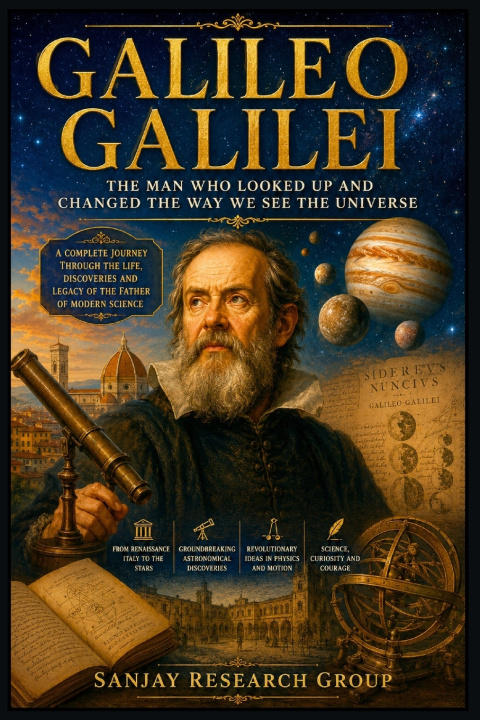
Galileo Galilei lived at a turning point between inherited systems of knowledge and a new approach to investigating nature. This book tells his story within that larger transformation. It opens by reconstructing Renaissance Italy: a politically divided region enriched by trade, art, universities, classical learning, religious authority, and influential patrons. It then widens its view to Europe before the Scientific Revolution, explaining the importance of Aristotle, Ptolemy, scholastic education, the Catholic Church, Islamic scholarship, printing, exploration, and the heliocentric proposal of Nicolaus Copernicus. This background allows readers to understand why Galileo's methods and conclusions could appear both compelling and disruptive.
The biographical chapters follow Galileo from his birth in Pisa in 1564 through his childhood, education, family responsibilities, and early academic appointments. Particular attention is given to his father, Vincenzo Galilei, whose work in music joined mathematical relationships with practical testing. That influence becomes a central thread in Galileo's development: nature was not merely to be discussed through respected authorities but examined through measurement, comparison, and experiment. The narrative also explores Galileo's discovery of mathematics, his reported observation of pendular motion, his teaching at Pisa and Padua, his family life, and his dependence on friends, students, and patrons.
A major portion of the book examines Galileo's scientific work. Readers are introduced to instruments available before him, his improvement and use of the telescope, and the observations that changed astronomy. These include the uneven surface of the Moon, the four large moons orbiting Jupiter, the phases of Venus, the puzzling appearance of Saturn, sunspots, solar rotation, and the multitude of stars composing the Milky Way. The book also considers The Starry Messenger and Galileo's intellectual relationship with Johannes Kepler. Alongside astronomy, it surveys his investigations of falling bodies, motion, inertia, pendulums, hydrostatics, mechanics, geometry, and devices such as the thermoscope.
The book's principal themes are curiosity, evidence, mathematical reasoning, intellectual courage, and the tension between innovation and established authority. It also shows that science develops within society: discoveries depend on education, instruments, communication, financial support, reputation, and debate. Galileo emerges not as an isolated genius but as a participant in a broad and evolving community of artisans, scholars, patrons, theologians, and observers.
Written for students, educators, young adults, and general readers, this volume requires no specialized knowledge of astronomy or physics. It offers a clear foundation for understanding Galileo's achievements and the historical world in which they occurred. Readers will gain familiarity with key Renaissance ideas, major astronomical discoveries, early concepts in physics, and the gradual formation of experimental science. More importantly, they will see how careful observation and disciplined questioning can alter humanity's understanding of the universe.
By Sanjay Mandavi


About the book
English
