
 Contact
 How to shop
Delivery
Shopping guide
 English
 56 b
56 b
 New
New
Up to 30 days for returns

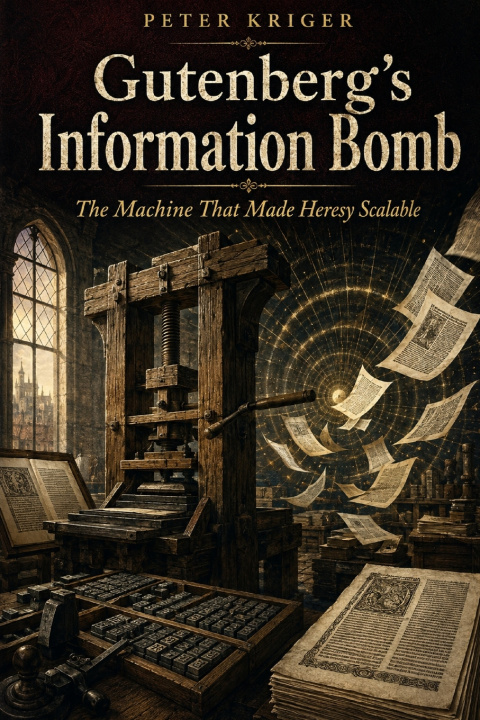
For eight hundred years, everything needed to print a book already existed. China was printing whole libraries from carved blocks in the ninth century. Korea was casting metal type before Gutenberg was born. Rome had the alphabet, the screw press, and the art of striking a hard punch into soft metal to make identical objects by the thousand. And nothing happened.
Then, in a middling German river town, a bankrupt goldsmith with a talent for lawsuits put the pieces together, and within seventy years the unity of Western Christendom was gone.
This book asks the question the usual story skips: not how the printing press worked, but why it waited. The answer turns out to have almost nothing to do with genius and a great deal to do with linen underwear, the price of a calf, the number of letters in an alphabet, and the useful European habit of having a different ruler every fifty miles.
Out of that investigation comes a testable rule. A technology of copying does not detonate when it is invented. It detonates when four conditions arrive together: a cheap substrate, a reproducible unit, a paying customer nobody is serving, and somewhere else to print. Korea had two of the four. China had the wrong unit. Rome had cheap slaves, which is the same as having no reason to invent anything.
Then the same four conditions are turned on our own century. The internet ran for twenty-four years before it did anything at all, and what finally released it was not a technical breakthrough but the lifting of a rule against selling things. Artificial intelligence sat in the same holding pattern for thirty years while the cost of computation fell. Both stories rhyme with Mainz more closely than the usual comparisons admit - and diverge from it in one respect that ought to worry us, since printing's great gift was the identical copy, and the identical copy is precisely what we are now busy abolishing.
A history of the first information explosion, written for people living through the next one.
Keywords: printing press, Gutenberg, information technology, Reformation, media history, artificial intelligence, history of the book


About the book
English
Categories

Give this book today
It's easy
1 Add to cart and choose Deliver as present at the checkout 2 We'll send you a voucher 3 The book will arrive at the recipient's addressHi! I'm Libroamiko, your book advisor.
How can I help you?