
 Contact
 How to shop
Delivery
Shopping guide
 English
 45 b
45 b
 New
New
Up to 30 days for returns

In 1948, readers wrote to The New Yorker asking where the lotteries were held, and whether they could go and watch.
They were not careless readers. They had read a document - a story that opens with the weather, gives the population of the village, the hour the proceedings begin, and the fact that the whole thing is over in time for people to get home for noon dinner. A national readership could not locate the fiction in it. That is not an accident of 1948. It is the technique, working exactly as designed.
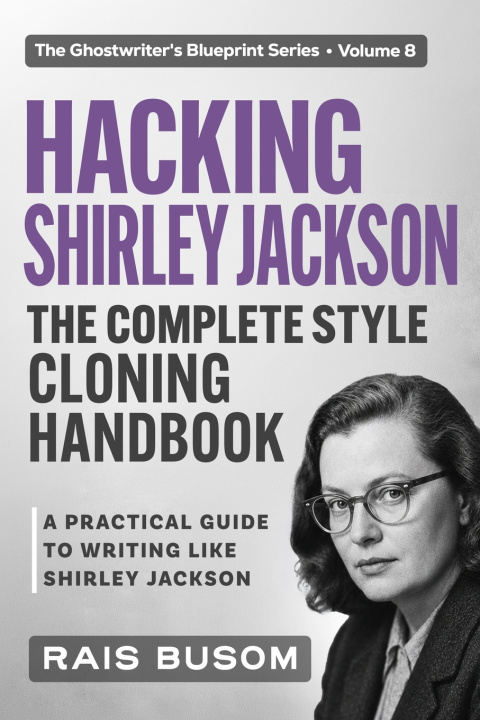
This handbook takes it apart.
The argument, and it can be proved
In 1959 Jackson published the most celebrated opening paragraph in American horror. Six years earlier she had published a comic memoir about moving her family into a large old house in Vermont. The two openings are the same machine: the same sentence shapes, the same punctuation, the same accelerating catalogue. In the novel the last words are walked alone. In the memoir they are literally thousands of socks. Change the last noun and you change the genre.
Three things you have been told that are not true
- "The Lottery" is not written in short sentences. Its opening paragraph is 117 words in two sentences - an average of 58.5. The flatness is administrative content, not brevity.
- The canonical openings contain no simile and no metaphor. Not one. The atmosphere comes from six devices, none of which is an image.
- Jackson puts adverbs on her dialogue tags. Strip them to obey modern workshop orthodoxy and you will write something colder and thinner than Jackson, and be unable to say why.
What you will be able to do
Generate dread without gore, monsters, or a raised voice. Build an unreliable narrator who never lies - and the harder one, who reports the world accurately and her own wants falsely. Plant a domestic object in the first three hundred words that kills somebody in the last three hundred. Hold one tone across ordinary and terrible material, which is the whole method.
How it teaches
Fourteen chapters across seven parts. Fifteen exercises, each with criteria for grading your own answer. Four fully worked model answers, including the capstone - the one exercise you cannot learn by copying Jackson, because Jackson never wrote it. A failure gallery of the six ways Jackson pastiche goes wrong, each with its diagnosis and repair. A four-author comparison against Hemingway, Auster and le Carré. And five ready-to-run lessons for anyone who has to teach "The Lottery" on a Tuesday.
Counted, not asserted
There is no stylometric study of Jackson's prose - none. So this book prints its own counts and lists the passages it measured, so any reader with the text in front of them can reproduce every figure in an afternoon. A statistic you are told is a fact you will forget. A statistic you have counted yourself is a habit.
The Ghostwriter's Blueprint, Volume 6. Count first. Describe second. Imitate third. Then decide what to do with what you have learned.


About the book
English

Give this book today
It's easy
1 Add to cart and choose Deliver as present at the checkout 2 We'll send you a voucher 3 The book will arrive at the recipient's addressHi! I'm Libroamiko, your book advisor.
How can I help you?