
 Contact
 How to shop

Delivery
Shopping guide
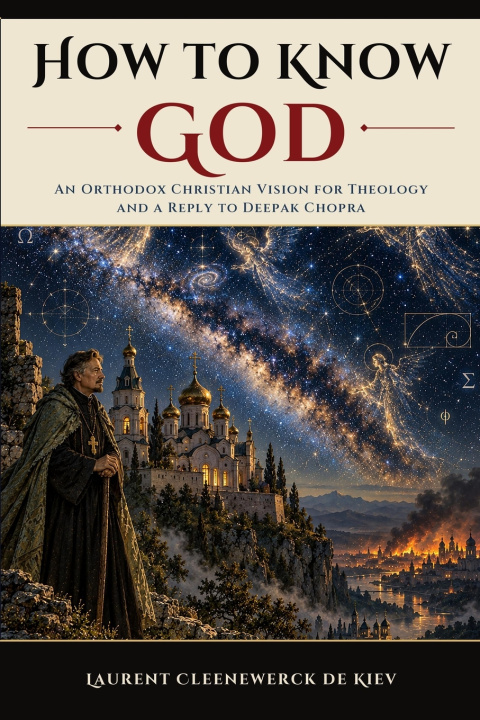
HOW TO KNOW GOD
An Orthodox Christian Vision for Theology and a Reply to Deepak Chopra
 English
 66 b
 Coming soon
 New
Up to 30 days for returns

How do we pray to a God we have never met? How would we know him if we saw him?
In 2000, Deepak Chopra asked one of the best questions ever printed on the cover of a book: How to Know God. His answer, drawn from the nondualism of Vedanta, was that God is the deepest layer of our own consciousness, to be known "by looking in the mirror." Fr Laurent Cleenewerck de Kiev, who once walked that road himself, takes the question just as seriously and gives a different answer: God is found not in a mirror, but in a Face.
The key to this book is a single observation: to know God is to recognize him. In the Scriptures, knowing God is rarely a matter of information. It is the knowledge of Emmaus, where two disciples walked beside the risen Christ without knowing him until, in the breaking of the bread, "their eyes were opened, and they recognized him" (Luke 24:31).
In thirty-four chapters, each one a place where God may be recognized, the book moves in three stages:
- The footprints of God in the world: the wonder of creation, the transcendence of mathematics, the great physicists from Planck and Einstein to Lemaître, the mystery of consciousness, our sense of right and wrong, our hunger for meaning, beauty, and the face of another person.
- The Face of God in Jesus Christ: the encounter with Christ, the Incarnation, the voice of the Scriptures, the Cross, the miraculous, and the uncreated light of the Transfiguration and the Resurrection.
- The Face met again in the life of the Church: the breaking of the bread, the gaze of the icon, mystical peace, the dark cloud of unknowing, the mystery of evil, the discernment of spirits, dreams, suffering, unexpected provision, animal life, the face of a child, the faces of the poor, the saints, and the hour of our death.
In every chapter, the author engages Chopra directly. He credits what Chopra gets right: science and the spiritual life are not enemies, and God must be real rather than an abstraction. He then shows where the Orthodox Christian tradition parts company. The goal of the spiritual life is not the dissolution of the knower into the known, but theosis, a communion in which the person remains, is loved, and loves in return. A closing chapter carries the question into the age of artificial intelligence and asks what no machine, however perfect a mirror, can give.
Woven through the book is a personal story, from a boyhood atheism in Montpellier, through the Upanishads and quantum physics, to the Orthodox Church. How to Know God is written for seekers, for Christians who want to understand their own faith more deeply, and for every reader of Deepak Chopra who has wondered whether there is Someone on the other side of the mirror.
About the Author
Fr Laurent A. Cleenewerck de Kiev is a French-American Orthodox priest and theologian. He is the editor of the Eastern Orthodox Bible (EOB) and the author of His Broken Body, a study of Orthodox ecclesiology. Trained at St Tikhon's Orthodox Theological Seminary and St Sergius in Paris, he has also taught physics and economics, and he has spent some forty-five years with the question in this book's title.


About the book
English
Categories

Give this book today
It's easy
1 Add to cart and choose Deliver as present at the checkout 2 We'll send you a voucher 3 The book will arrive at the recipient's addressHi! I'm Libroamiko, your book advisor.
How can I help you?