
 Contact
 How to shop
Delivery
Shopping guide
Imposters
A Study of Pronominal Agreement
 English
 29 b
29 b
30-day return policy
Customers also purchased

















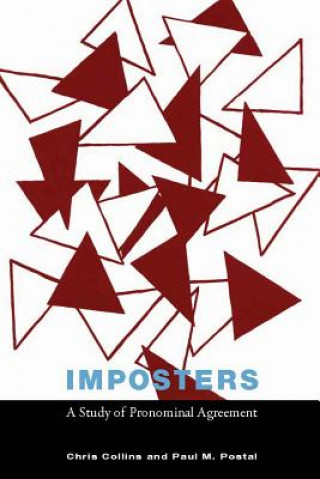
Normally, a speaker uses a first person singular pronoun (in English, I, me, mine, myself) to refer to himself or herself. To refer to a single addressee, a speaker uses second person pronouns (you, yours, yourself). But sometimes third person nonpronominal DPs are used to refer to the speaker--for example, this reporter, yours truly--or to the addressee--my lord, the baroness, Madam (Is Madam not feeling well?). Chris Collins and Paul Postal refer to these DPs as imposters because their third person exterior hides a first or second person core. In this book they study the interactions of imposters with a range of grammatical phenomena, including pronominal agreement, coordinate structures, Principle C phenomena, epithets, fake indexicals, and a property of pronominal agreement they call homogeneity. They conclude that traditional ideas about pronominal features (person, number, gender), which countenance only agreement with an antecedent or the relation of the pronoun to its referent, are much too simple. They sketch elements of a more sophisticated view and argue for its relevance and explanatory power in several data realms. The fundamental proposal of the book is that a pronoun agrees with what they call a source, where its antecedent constitutes only one type of source. They argue that the study of imposters (and closely related camouflage DPs) has far-reaching consequences that are inconsistent with many current theories of anaphora.


About the book
English

Give this book today
It's easy
1 Add to cart and choose Deliver as present at the checkout 2 We'll send you a voucher 3 The book will arrive at the recipient's addressYou might also be interested in









 /
/
 Paperback
 19.44
€
19.44
€
 /
Hardback
51.75
€
/
Hardback
51.75
€



Hi! I'm Libroamiko, your book advisor.
How can I help you?