
 Contact
 How to shop
Delivery
Shopping guide
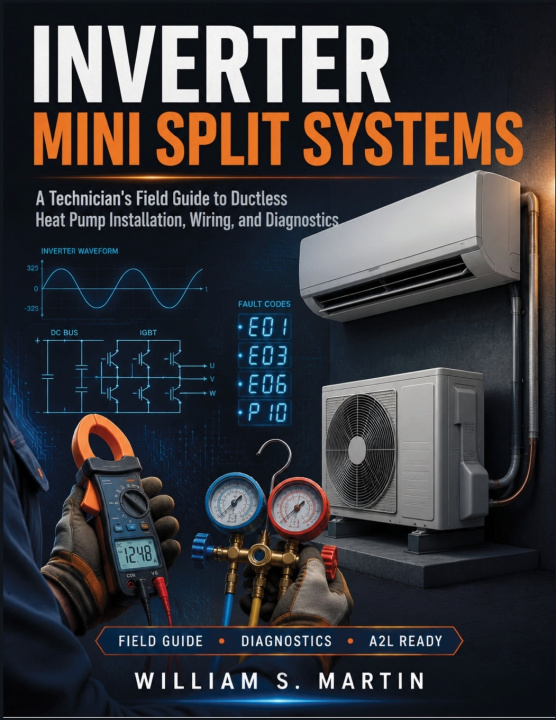
Inverter Mini Split Systems
A Technician's Field Guide to Ductless Heat Pump Installation, Wiring, and Diagnostics
 English
 219 b
219 b
 New
New
Up to 30 days for returns

The equipment on the service truck has changed faster than the training behind it.
A ductless inverter mini split behaves nothing like the single-stage, fixed-orifice equipment many technicians trained on. A variable-speed compressor, an electronic expansion valve, a power-electronics drive, and two control boards trading serial data create failure modes the old contactor-and-capacitor playbook was never built to read.
Faced with a system that simply isn't cooling, it is tempting to replace the part most often blamed - and when that guess is wrong, the customer has paid for an unneeded board, the real fault is still there, and the callback is already coming.
This field guide closes that gap. It builds an accurate picture of how these systems truly work, then teaches a systematic way to move from a symptom to its real cause across the electrical, refrigerant, and control domains - so every diagnosis is reasoned from evidence instead of guessed.
Inside, you will:
- Understand the inverter drive from the inside - rectifier, DC bus, and switching stage - so its readings and failures make sense.
- Take and interpret the measurements that matter - superheat and subcooling, DC-bus voltage, thermistor resistance, and evacuation in microns - with worked examples that track every unit.
- Localize a fault to one domain before opening anything, and read the system's own fault codes and live data as evidence.
- Tell an undercharge, an overcharge, and a restriction apart on an electronic-expansion-valve system, where old rules of thumb mislead.
- Install and commission correctly the first time - flaring, evacuation, and weighed-in charge decide a system's reliability.
- Work through the A2L refrigerant transition, where handling, leak-checking, and charging all change.
Coverage spans refrigeration and inverter fundamentals; the refrigerant landscape and A2L transition; the compressor, coil, reversing valve, and electronic expansion valve; dedicated circuits, conductor sizing, grounding, and inter-unit communication; control logic and communication faults; line-set work, brazing, evacuation, and charging by weight; commissioning and verification; and a repeatable diagnostic method - supported by worked examples, practice problems, a glossary, and quick-reference appendices.
It is written for working service and installation technicians moving from conventional to variable-speed ductless equipment, for apprentices and trade students building a foundation, and for instructors who need a clear, field-oriented reference.
Open the guide and start installing and diagnosing these systems from real understanding - one clear, measured step at a time.


About the book
English

Give this book today
It's easy
1 Add to cart and choose Deliver as present at the checkout 2 We'll send you a voucher 3 The book will arrive at the recipient's addressHi! I'm Libroamiko, your book advisor.
How can I help you?