
 Contact
 How to shop

Delivery
Shopping guide
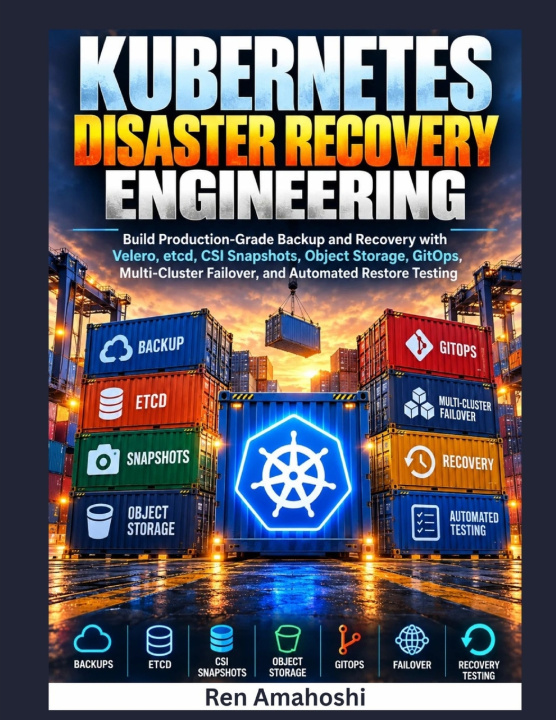
KUBERNETES DISASTER RECOVERY ENGINEERING
Build Production-Grade Backup and Recovery with Velero, etcd, CSI Snapshots, Object Storage, GitOps, Multi-Cluster Failover, and Automated Restore Testing
 English
 77 b
 Coming soon
 New
Up to 30 days for returns

KUBERNETES DISASTER RECOVERY ENGINEERING
Build Production-Grade Backup and Recovery with Velero, etcd, CSI Snapshots, Object Storage, GitOps, Multi-Cluster Failover, and Automated Restore Testing
Your Kubernetes backups are running. But can you confidently restore your applications, databases, and entire cluster when disaster strikes?
A successful backup does not guarantee successful recovery. When persistent volumes fail, databases become corrupted, control-plane components crash, or entire Kubernetes clusters become unavailable, recovery requires more than restoring YAML manifests.
KUBERNETES DISASTER RECOVERY ENGINEERING is a comprehensive, hands-on guide to designing, implementing, securing, and validating reliable Kubernetes disaster recovery solutions.
Built around Kubernetes 1.37 and Velero 1.18, this practical guide takes you from disaster recovery architecture to real-world backup implementation, persistent data protection, automated infrastructure reconstruction, and multi-cluster failover.
What You'll Learn
1. Kubernetes Disaster Recovery Architecture: Design reliable recovery strategies, identify failure domains, and establish measurable Recovery Point Objectives (RPOs) and Recovery Time Objectives (RTOs).
2. Velero Backup and Restore: Configure Velero 1.18, S3-compatible object storage, automated backup schedules, retention policies, and Kubernetes workload restoration.
3. etcd and Control-Plane Recovery: Create verified etcd snapshots, protect critical cluster configuration, and restore failed self-managed Kubernetes control planes.
4. CSI Snapshots and Kopia Data Movement: Protect persistent volumes using CSI snapshots, Velero Node Agent, Kopia repositories, and independent object storage.
5. PostgreSQL Disaster Recovery: Implement CloudNativePG backups, WAL archiving, point-in-time recovery, and database integrity validation.
6. Infrastructure Automation and GitOps: Rebuild Kubernetes environments using Terraform/OpenTofu, Helm, Kustomize, and Argo CD.
7. Multi-Cluster Failover and Failback: Restore workloads across clusters, manage storage portability, prevent conflicting database writes, and safely redirect application traffic.
8. Cyber-Resilient Backups: Implement immutable storage, encryption, independent recovery credentials, and ransomware-resistant recovery practices.
9. Automated Recovery Testing: Integrate Prometheus, Grafana, Argo Workflows, and controlled failure simulations to monitor backup health and validate recovery performance.
Complete Hands-On Capstone Project
Put everything into practice through a full-stack Kubernetes disaster recovery project. Build primary and recovery clusters, configure backup protection, simulate namespace deletion, storage failures, database corruption, and cluster outages, then restore applications, recover persistent data, execute multi-cluster failover, and measure recovery success against defined RPO/RTO objectives.
Who This Book Is For
Ideal for Kubernetes Administrators, DevOps Engineers, Site Reliability Engineers (SREs), Platform Engineers, Cloud Architects, and IT Professionals responsible for building reliable, secure, and recoverable Kubernetes environments.
Why This Book?
Kubernetes high availability is not disaster recovery. Replicated infrastructure cannot independently protect against every data loss scenario, and successful backups mean little without verified restoration.
This book delivers the practical knowledge, configurations, recovery workflows, and troubleshooting techniques needed to move beyond basic backups toward dependable, production-grade disaster recovery.
Don't just back up Kubernetes. Learn to rebuild it, recover its data, and prove your applications can survive disaster.


About the book
English

Give this book today
It's easy
1 Add to cart and choose Deliver as present at the checkout 2 We'll send you a voucher 3 The book will arrive at the recipient's addressHi! I'm Libroamiko, your book advisor.
How can I help you?