
 Contact
 How to shop

Delivery
Shopping guide
 English
 30 b
 Coming soon
 New
Up to 30 days for returns

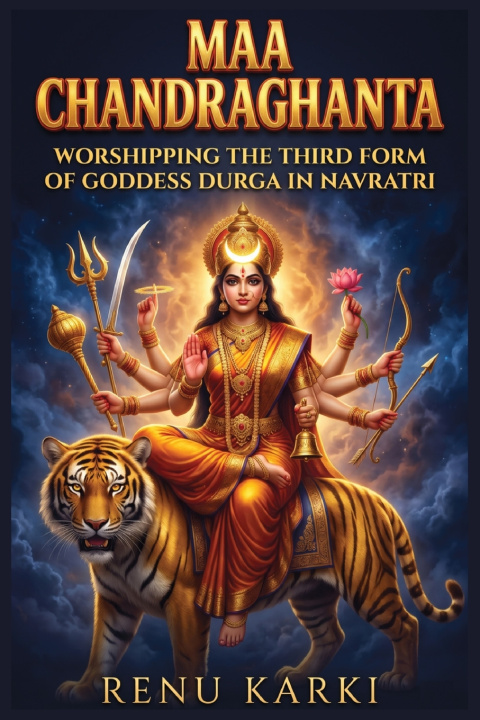
For dedicated practitioners and students of classical Hindu traditions, the third day of Navratri presents a profound shift in cosmic energy. How does one accurately honor Maa Chandraghanta, the ten-armed warrior goddess who perfectly balances fierce protection with absolute maternal benevolence during the sacred nine nights of Goddess worship?
This text provides a thorough examination of the third Navadurga, moving beyond surface-level mythology to analyze her deep significance within Shakta philosophy. Worshipping the third form of Goddess Durga in Navratri requires an understanding of her unique iconography. Crowned with a bell-shaped half-moon, her form represents the precise moment Goddess Parvati shifted from solitary ascetic penance into a sovereign, battle-ready guardian. By exploring foundational Sanskrit texts like the Shiva Purana and the Devi Mahatmyam, readers gain historical insight into her emergence to restore cosmic order.
Understanding Hindu goddess worship and the specific Navratri day 3 rituals involves multiple layers of spiritual practice. The narrative bridges ancient theology with Tantric chakra psychology, explaining how the resonance of her divine bell-the Nada Brahma-activates the Manipura chakra, or solar plexus. Furthermore, it details her crucial relationship with Vedic astrology. Because Maa Chandraghanta governs the planet Venus (Shukra Graha), learning how to perform her puja at home offers exact astrological remedies for harmonizing material wealth, artistic creativity, and emotional stability. By anchoring these esoteric concepts in clear, actionable tradition, the text serves as a definitive resource for authentic Navaratri fasting and domestic rituals.
This text distinguishes itself through an uncompromising commitment to scriptural accuracy and structural clarity. Rather than offering scattered mythological summaries, it provides a meticulously organized framework that integrates history, astrology, and liturgical instruction into a single, cohesive volume. The inclusion of a 22-term semantic glossary of Sanskrit phrases ensures that even the most complex theological concepts remain entirely accessible to modern readers. With clean, audio-friendly prose and precise translations, this edition stands as an essential reference for anyone seeking to preserve and practice classical Shakta heritage with historical integrity and devotional exactness.


About the book
English

Give this book today
It's easy
1 Add to cart and choose Deliver as present at the checkout 2 We'll send you a voucher 3 The book will arrive at the recipient's addressHi! I'm Libroamiko, your book advisor.
How can I help you?