
 Contact
 How to shop

Delivery
Shopping guide
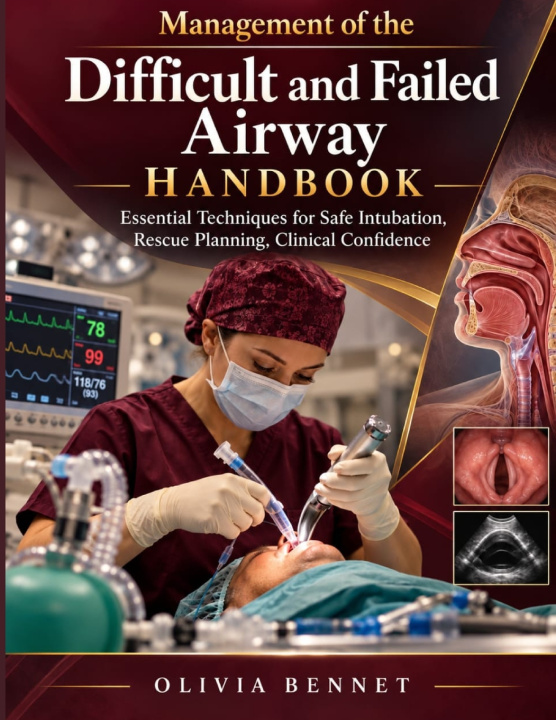
Management of the Difficult and Failed Airway Handbook
Essential Techniques for Safe Intubation ,Rescue Planning, Clinical Confidence
 English
 272 b
 New
Up to 30 days for returns

When the Airway Becomes Difficult, Preparation Matters Most.
A challenging airway can transform an ordinary clinical situation into a rapidly evolving emergency. In those critical moments, clinicians need more than technical skill-they need preparation, structured assessment, sound judgment, and a clear approach to airway management.
Management of the Difficult and Failed Airway Handbook provides a focused resource for understanding the challenges associated with difficult and failed airway management. It explores essential concepts that can help healthcare professionals recognize potential difficulties, prepare appropriately, communicate effectively, and approach airway challenges systematically.
What You'll Discover InsideUnderstanding the difficult airway - Explore the factors that can make airway management challenging and the importance of recognizing potential difficulty early.
Airway assessment - Review foundational approaches to evaluating patients and identifying features that may signal increased airway-management complexity.
Preparation and planning - Understand why equipment readiness, team preparation, patient positioning, and contingency planning are essential.
Structured decision-making - Develop a systematic framework for thinking through challenging airway situations.
Difficult and failed airway concepts - Examine the distinction between anticipated difficulty and situations in which initial airway-management attempts are unsuccessful.
Airway management strategies - Explore the principles behind different approaches and the importance of selecting techniques appropriate to the clinical situation and available expertise.
Patient safety and risk awareness - Emphasize oxygenation, monitoring, communication, and timely recognition of deterioration.
Teamwork and communication - Understand how coordinated teamwork and clear communication can contribute to safer airway management.
Alternative approaches and rescue planning - Build awareness of the importance of having backup strategies when the initial plan does not succeed.
Post-airway considerations - Recognize that successful airway management extends beyond securing the airway and includes ongoing monitoring and patient care.
A valuable learning companion - Useful for clinicians, trainees, students, and healthcare professionals seeking to strengthen their foundational knowledge of difficult airway management.
The difficult airway is not simply a technical problem-it is a clinical decision-making challenge that requires anticipation, preparation, and the ability to adapt when circumstances change.
This handbook encourages readers to think beyond a single technique and instead develop a structured approach: assess the patient, anticipate difficulty, prepare the team and equipment, establish a plan, recognize when the plan is failing, and move appropriately to the next strategy.
Whether you are studying airway management, preparing for clinical practice, or seeking to reinforce your understanding of difficult and failed airway concepts, Management of the Difficult and Failed Airway Handbook offers a focused foundation for approaching one of the most demanding areas of acute clinical care.
Assess early. Prepare carefully. Think systematically. Keep oxygenation and patient safety at the center.


About the book
English

Give this book today
It's easy
1 Add to cart and choose Deliver as present at the checkout 2 We'll send you a voucher 3 The book will arrive at the recipient's addressHi! I'm Libroamiko, your book advisor.
How can I help you?