
 Contact
 How to shop
Delivery
Shopping guide
PLC Engineering Advanced
Safety PLCs, Motion Control, Redundancy, SCADA and System Commissioning
 English
 45 b
45 b
 New
New
Up to 30 days for returns

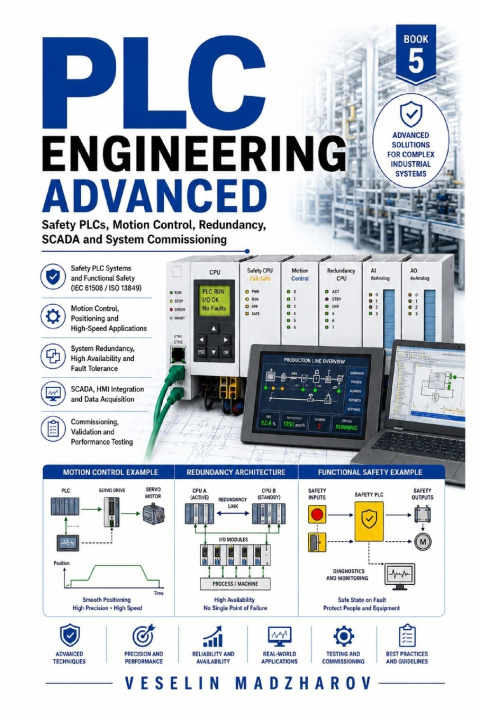
PLC Engineering Advanced is a practical guide to designing, integrating, commissioning, and maintaining complex industrial automation systems.
Modern PLC engineering extends far beyond basic logic and ordinary input and output control. Advanced installations must coordinate functional safety, servo motion, redundant controllers, industrial networks, HMI and SCADA systems, historical data, cybersecurity, and production requirements. All these technologies must operate as one reliable and diagnosable system.
This book explains how to approach these challenges using practical, vendor-neutral engineering methods that can be applied across different PLC platforms and industrial environments.
Readers will learn how safety PLC systems detect hazardous conditions and bring machinery to a defined safe state. The book introduces functional safety architecture, safety inputs and outputs, diagnostic coverage, reset behavior, restart prevention, proof testing, and validation principles based on IEC 61508 and ISO 13849 concepts.
The motion-control sections explain servo drives, positioning, electronic gearing, coordinated axes, homing, following error, tuning, mechanical limitations, and safe motion. Practical examples demonstrate how controller commands, drive parameters, feedback devices, and machine mechanics affect precision and cycle time.
High-availability chapters examine active and standby controllers, state synchronization, redundant networks, duplicated power supplies, output ownership, automatic failover, common-cause failures, and recovery testing. The book explains why controller redundancy alone cannot remove every single point of failure.
SCADA and HMI integration is covered through tag design, operator displays, commands, alarms, historical data, trends, OPC UA communication, time synchronization, data quality, reporting, user permissions, and secure remote access.
Commissioning and validation sections provide structured methods for construction verification, power checks, network testing, I/O checkout, loop testing, cause-and-effect verification, sequence testing, FAT, SAT, performance testing, fault injection, endurance testing, and operational handover.
Inside the book, readers will also find practical guidance on:
Safety PLC architecture and functional safety
Servo positioning and coordinated motion
Redundant PLC and network design
SCADA, HMI, historian, and data acquisition
Alarm management and diagnostic information
Industrial cybersecurity and access control
System commissioning and validation
Performance and capacity testing
Backup, restoration, and lifecycle management
Intermittent-fault investigation
Root-cause analysis and corrective action
Engineering checklists and reference tables
Realistic industrial cases demonstrate how failures develop across the boundaries between software, wiring, networks, drives, sensors, safety systems, mechanical equipment, and operator actions.
PLC Engineering Advanced is written for automation engineers, PLC programmers, maintenance technicians, electricians, commissioning specialists, system integrators, and technical professionals who already understand basic PLC principles and want to develop complete industrial systems.
Design safer control systems. Coordinate motion accurately. Improve availability. Diagnose complex failures. Commission industrial automation with confidence.


About the book
English

Give this book today
It's easy
1 Add to cart and choose Deliver as present at the checkout 2 We'll send you a voucher 3 The book will arrive at the recipient's addressHi! I'm Libroamiko, your book advisor.
How can I help you?