
 Contact
 How to shop
Delivery
Shopping guide
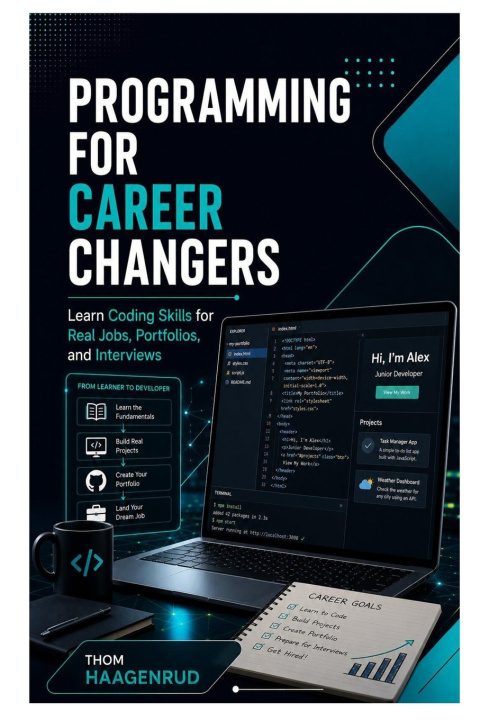
Programming for Career Changers
Learn Coding Skills for Real Jobs, Portfolios, and Interviews
 English
 46 b
46 b
 Coming soon
 New
New
Up to 30 days for returns

Do you want to move into software development without wasting time on scattered tutorials, random tools, or projects that do not prove job-ready ability?
Programming for Career Changers is a practical, beginner-friendly guide for adults, students, self-taught learners, and working professionals who want a structured path into programming and junior developer work. Instead of treating coding as a collection of syntax lessons, this book connects programming fundamentals to the professional skills employers expect: Git, testing, SQL, APIs, security, deployment, portfolio evidence, applications, interviews, and workplace readiness.
You will begin by treating your career change as an engineering project. You will define a target role, assess your available time and constraints, identify transferable experience, choose a focused technology path, and build evidence before changing your professional identity. From there, you will learn Python through practice and gradually develop a realistic software project called IssueTrack Lite.
The book follows a four-part progression. Part I helps you plan the transition by selecting a realistic role, identifying transferable experience, choosing a technology path, and building a learning system. Part II teaches programming through Python and the evolving IssueTrack Lite project. Part III adds professional developer practices: Git, GitHub, debugging, testing, SQL, APIs, security, Docker, CI, and deployment. Part IV converts the work into employment evidence through portfolio projects, job applications, interviews, offer evaluation, and first-role readiness.
The central technical project is IssueTrack Lite, a small issue-management application. It begins as a command-line program and gradually gains validation, structured records, modules, persistent storage, automated tests, SQLite, a FastAPI service, security controls, Docker containerization, GitHub Actions, and deployment. This progression shows how professional practices connect instead of appearing as unrelated tools.
The book also includes a Domain Transfer Project, helping career changers use previous experience as an advantage. Instead of copying another generic tutorial app, you will adapt technical ideas to a workflow you already understand from prior education, employment, administration, finance, operations, teaching, support, research, compliance, or another field.
This book teaches employment evidence, not vague confidence. You will learn to produce working code, useful tests, database queries, commit history, clear documentation, project case studies, deployment evidence, portfolio explanations, and interview-ready stories that show how you think and work.
No previous programming experience, computer science degree, advanced mathematics, command-line knowledge, or expensive computer is required. You should be able to use a computer, create and organize files, install ordinary applications, browse the web, follow written instructions, practise consistently, and communicate clearly.
Whether you are changing careers, preparing for junior backend work, aiming for automation roles, strengthening fragmented self-taught knowledge, moving toward QA automation, technical support engineering, implementation engineering, or data and business automation, this book gives you a structured route from beginner programming to credible professional evidence.
Stop treating a career change as a collection of disconnected courses. Learn how to build coding skill, professional habits, portfolio evidence, and interview readiness through a practical path designed for real constraints and real software work.


About the book
English

Give this book today
It's easy
1 Add to cart and choose Deliver as present at the checkout 2 We'll send you a voucher 3 The book will arrive at the recipient's addressHi! I'm Libroamiko, your book advisor.
How can I help you?