
 Contact
 How to shop

Delivery
Shopping guide
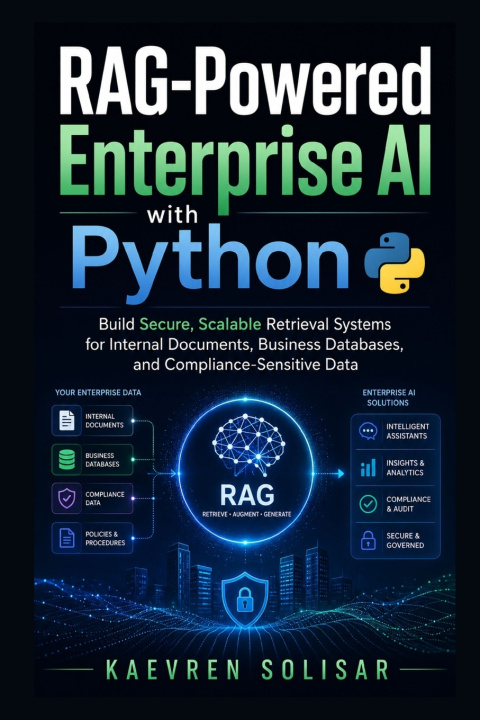
RAG-Powered Enterprise AI with Python
Build Secure, Scalable Retrieval Systems for Internal Documents, Business Databases, and Compliance-Sensitive Data
 English
 66 b
 New
Up to 30 days for returns

Your RAG prototype works until a user asks about a restricted policy, a messy document, or sensitive data. A confident answer is not enough when accuracy, access control, and traceability matter.
RAG-Powered Enterprise AI with Python is a practical, code-first guide to building secure, scalable retrieval-augmented generation (RAG) systems. Connect large language models (LLMs) to internal documents and business databases.
Build Enterprise RAG That Goes Beyond the Demo
Follow the Secure Retrieval Stack, a five-layer architecture covering document ingestion, hybrid retrieval, access control, audit logging, and evaluation. See how these layers work together.
What You'll Learn
Architect a Python RAG pipeline from ingestion to grounded answers.
Prepare internal documents with chunking and metadata strategies.
Combine vector search, keyword search, and reranking for more relevant retrieval.
Connect retrieval to structured business databases, not only documents.
Apply role-based access control (RBAC) and data isolation to protect restricted content.
Capture audit logs and observability to investigate requests.
Identify LLM hallucinations, missing evidence, and weak grounding.
Build golden question sets and use automated evaluation metrics.
Diagnose errors in retrieval or generation.
Deploy and scale with Docker and reliable releases.
Secure Retrieval for Sensitive Business Data
A relevant result is not always a permitted result. Explore permission-aware retrieval, access boundaries, and data isolation to help protect sensitive information.
Treat authorization as part of the retrieval architecture, not a filter added after the model has seen restricted data. Security starts with pipeline design.
Improve Accuracy with Hybrid Search and Evaluation
Vector embeddings are useful, but similarity alone does not guarantee reliable evidence. Discover how hybrid retrieval, reranking, metadata, and document preparation work together to surface better context.
A fluent answer can still be wrong. Use repeatable test questions, evaluation metrics, and failure analysis to understand what went wrong and whether the problem began with retrieval or generation.
Learn Through Runnable Python Code
Each chapter pairs an architectural decision with runnable Python code, a verified case study, and a hands-on exercise. Build one enterprise RAG pipeline from setup through deployment.
Understand why each design choice matters and adapt the approach to different internal knowledge sources.
Who This Book Is For
Python developers moving from LLM prototypes to production-focused applications.
AI and data engineers building search and retrieval over private organizational data.
Solution architects designing systems with security, auditing, and access requirements.
Technical teams working with regulated or compliance-sensitive information.
Build for Real-World Enterprise Questions
What happens when a document includes nested tables, a user lacks permission, or a question exposes a gap in your test set? Learn to inspect evidence, trace requests, and improve the pipeline instead of trusting fluent answers.
Move beyond a RAG demo that looks finished. Build an enterprise AI retrieval system designed to be testable, explainable, and ready for serious deployment work.


About the book
English

Give this book today
It's easy
1 Add to cart and choose Deliver as present at the checkout 2 We'll send you a voucher 3 The book will arrive at the recipient's addressHi! I'm Libroamiko, your book advisor.
How can I help you?