
 Contact
 How to shop
Delivery
Shopping guide
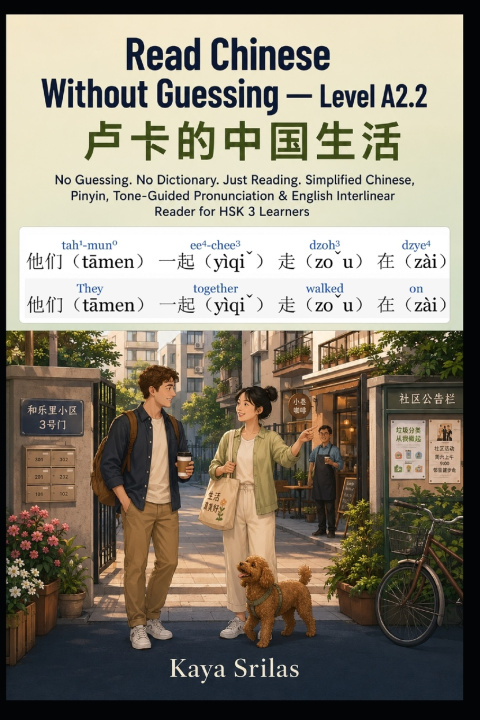
Read Chinese Without Guessing - Level A2.2
卢卡的中国生活 - No Guessing. No Dictionary. Just Reading. Simplified Chinese, Pinyin, Tone-Guided Pronunciation & English Interlinear Reader for HSK 3 Learners
 English
 69 b
69 b
 New
New
Up to 30 days for returns

Read Chinese Without Guessing - Level A2.2 brings everyday Chinese into readable stories.
Follow 卢卡(Lúkǎ / Lucas) as he learns to live more like a local. With help from 小雨(Xiǎoyǔ / Xiaoyu), 王先生(Wáng Xiānsheng / Mr. Wang), and his dog 可可(Kěkě / Coco), he learns what is allowed, forbidden, required, possible, and achieved.
No guessing.
No dictionary.
Just reading.
Read Chinese in Four Clear Layers
Stories combine hanzi, pinyin, tone-guided English pronunciation, and natural English meaning on the same page. Blue shows pronunciation; purple shows meaning. Read, speak, and understand without stopping to search elsewhere.
The interlinear version keeps full support. The clean Chinese version lets you test yourself with the same story, with pinyin on every word at this level.
Two Powerful New Skills
Choose the Right "Can"
English uses one word, can. Chinese uses three:
- 会(huì) - a learned skill
- 能(néng) - circumstances allow it
- 可以(kěyǐ) - permission
Ask: Is this a skill, a circumstance, or permission? You will also learn obligation and prohibition through 要 / 得 / 必须 / 不用 / 不能 / 不要 / 别.
Say How an Action Turned Out
This book introduces the resultative complement: a verb joined directly to its outcome.
看懂 means to read and understand.
吃完 means to finish eating.
找到 means to look for something and find it.
Instead of saying only what happened, you begin saying what result the action produced. This pattern opens the complement system used throughout later levels.
Ten Story-Based Chapters
- Permission, rules, and obligation
- Shopping and measure words
- Comparisons with 比 and 最
- The three "cans": 会 / 能 / 可以
- Casual spoken Chinese
- Results such as 听懂、看完、找到
- Complete HSK 3 review
Lucas learns public rules and household customs, shops for a gift, compares Beijing and Xi'an, and discovers how much Chinese he can now use.
Inside Every Chapter
- Interlinear and clean Chinese stories
- HSK-style comprehension
- Vocabulary and useful expressions
- One focused grammar lesson
- Writing practice and answers
Designed for HSK 3 Learners
This book is ideal if you have completed A2.1 or can already describe simple past events using 了、没、过. It also suits visual learners who want pronunciation support without audio files or special apps.
By the end, you will be able to:
- Navigate permission, prohibition, and obligation
- Count objects with useful measure words
- Compare people, places, and experiences
- Choose the correct Chinese word for "can"
- Understand relaxed speech between friends
- Describe whether an action was finished, understood, found, or done correctly
Your reading vocabulary grows toward roughly 800-1400 words and about 650 cumulative characters, and prepares you for HSK 3.
Support That Grows With You
This is the final level where the clean Chinese version carries pinyin on every word. From B1.1, that optional version gradually removes pinyin from familiar words. The interlinear reading keeps hanzi, pinyin, pronunciation, and meaning together at every level.
Read Aloud. Understand More.
Read the pronunciation line, confirm the meaning, then return to the clean Chinese version. Complete the exercises, check the answers, and keep going.
By the final chapter, Lucas can say:
我会说中文了。
I can speak Chinese now.


About the book
English

Give this book today
It's easy
1 Add to cart and choose Deliver as present at the checkout 2 We'll send you a voucher 3 The book will arrive at the recipient's addressHi! I'm Libroamiko, your book advisor.
How can I help you?