
 Contact
 How to shop

Delivery
Shopping guide
 English
 48 b
 New
Up to 30 days for returns

The most famous date in the history of Roman Britain may be about the wrong country.
In 410, according to a Greek historian writing a century later, the emperor Honorius told the cities of Britain to see to their own defence. Schoolbooks made it the day the legions sailed home. But no legions sailed in 410. The last field army had been taken to Gaul by a usurper three years earlier, the Britons had thrown out the imperial officials themselves in 409, and the coin that paid the garrison had stopped arriving around 402. Since 1982 a good number of historians have thought the letter was addressed to Bruttium, in the toe of Italy, and that a copyist got the name wrong.
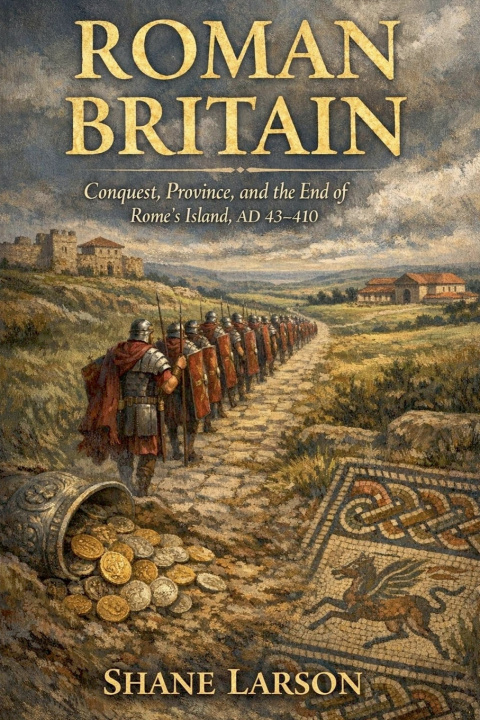
That is the problem and the pleasure of Roman Britain: 367 years, about as long as from the English Civil War to today, known mostly from the ground rather than from writers. This book tells the whole arc in one narrative. Claudius's sixteen days on the island in AD 43, elephants included, and the forty years of fighting his generals did afterwards. Agricola's victory in the far north in 83 or 84, followed by a retreat so complete that the army buried some 875,000 iron nails at Inchtuthil rather than leave them behind. Bathers at Bath cursing whoever stole their cloaks. Severus dying at York in 211. Carausius running Britain as his own empire for seven years. Constantine proclaimed at York in 306. The conspiracy of 367, Magnus Maximus marching the army away in 383, and a fourth century that was, in the villas of the Cotswolds, the richest the island would see until the Middle Ages.
Then the switching-off: the money, the army, the towns, the villas, one system after another, while the people who had lived in them stood and watched. It closes on the Hoxne hoard, buried after 407 and found in a Suffolk field in 1992.
Every chapter is built around a place or an object you can still see, and every claim says what it rests on: a Roman author with his own motives, an inscription, a coin series, a layer of burnt daub. Where historians disagree, you get the disagreement. The invasion beach, the Romanization debate, the date of Britain's first martyr and the meaning of 410 are presented as the open questions they are.
What you'll learn:
- Why the conquest of Britain never finished, and why Rome kept the island anyway
- What the curse tablets of Bath and the wax tablets of London say in the Britons' own hand
- Why a province at the edge of the world produced five men who claimed the purple
- How rich fourth-century Britain was, and who the wealth belonged to
- What the coins, towns and villas show about how Roman Britain actually ended
- Whether Honorius ever wrote to Britain at all
This book is for you if:
- You have read Boudica and want the rest of the story
- You have stood at Bath, Fishbourne, Chedworth or Richborough and want to know what you were looking at
- You want the fourth century given its full weight instead of hurried past on the way to the end
- You want to be told which Roman author said it, and why he might have had reasons
Nobody left in 410. The money just stopped arriving. This is the whole story of Rome's island, from Caesar's two summers to the last coin dropped at Richborough.


About the book
English

Give this book today
It's easy
1 Add to cart and choose Deliver as present at the checkout 2 We'll send you a voucher 3 The book will arrive at the recipient's addressHi! I'm Libroamiko, your book advisor.
How can I help you?