
 Contact
 How to shop
Delivery
Shopping guide
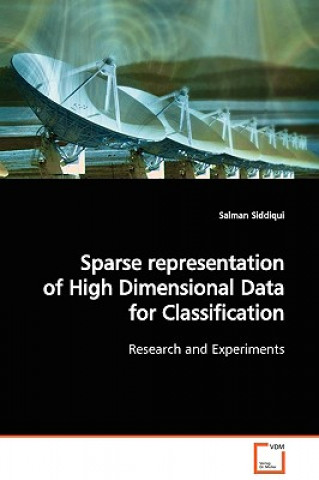
Sparse representation of High Dimensional Data for Classification
 English
 125 b
125 b
30-day return policy
Customers also purchased









 /
/
 Paperback
 29.87
€
29.87
€









In this book you will find the use of sparse §Principal Component Analysis (PCA) for representing §high dimensional data for classification. Sparse §transformation reduces the data §volume/dimensionality without loss of critical §information, so that it can be processed efficiently §and assimilated by a human. We obtained sparse §representation of high dimensional dataset using §Sparse Principal Component Analysis (SPCA) and §Direct formulation of Sparse Principal Component §Analysis (DSPCA). Later we performed classification §using k Nearest Neighbor (kNN) Method and compared §its result with regular PCA. The experiments were §performed on hyperspectral data and various datasets §obtained from University of California, Irvine (UCI) §machine learning dataset repository. The results §suggest that sparse data representation is desirable §because sparse representation enhances §interpretation. It also improves classification §performance with certain number of features and in §most of the cases classification performance is §similar to regular PCA.


About the book
English

Give this book today
It's easy
1 Add to cart and choose Deliver as present at the checkout 2 We'll send you a voucher 3 The book will arrive at the recipient's addressYou might also be interested in









 /
Paperback
16.70
€
/
Paperback
16.70
€




 /
Paperback
16.50
€
/
Paperback
16.50
€

 /
Paperback
19.33
€
/
Paperback
19.33
€


 /
Paperback
43.64
€
/
Paperback
43.64
€


 /
Paperback
30.17
€
/
Paperback
30.17
€

Hi! I'm Libroamiko, your book advisor.
How can I help you?