
 Contact
 How to shop

Delivery
Shopping guide
Substation Engineering Handbook
From Single-Line Diagram to Energization | A Step-by-Step Guide to High-Voltage Design, Grounding, Protective Relaying, SCADA, Testing, and Maintenance
 English
 172 b
 Coming soon
 New
Up to 30 days for returns

This book is for engineers and technicians who work on substations, or are about to, and want to see how the whole job fits together. If you know your own part of the work but feel unsure what the protection engineer or the commissioning team needs from you, this handbook was written for you.
Most engineers learn substation work one piece at a time, yet every piece depends on the others. The fault study sets the breaker ratings and the relay settings. The single-line diagram decides where every current transformer goes. The DC system decides whether a trip ever reaches the breaker.
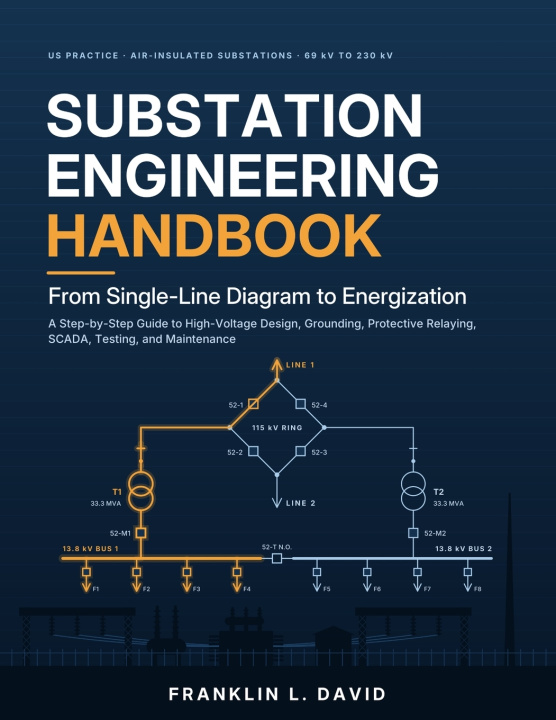
So this book follows one station through the order a real project runs. The reference substation is a hypothetical 115 kV ring bus with two transformers feeding a 13.8 kV switchgear lineup and eight feeders. Each chapter explains what the work has to achieve and why, then does it for that station and produces the document a real project would produce: a study, a drawing, a settings sheet or a test record.
Every chapter has at least one step-by-step procedure. Each step ends with a checkpoint that tells you what you should have before you move on, and each procedure closes with what a correct result looks like and what to check first when you don't get it.
In this book, you'll learn how to:
- How to read a single-line diagram, and build one the rest of the project can work from
- How to set up the fault and load studies that size the breakers, the grounding and the relay settings
- How to choose transformers, breakers, instrument transformers and arresters by the ratings that decide the choice
- How to design a ground grid and check its touch and step voltages
- How to set transformer, line, bus and feeder protection, including breaker failure and reclosing
- How to lay out the DC system, the control schematics and the SCADA points list so that trips and alarms reach the right place
- How to test, commission and energize a station in a checked, safe order
- How to trace a problem to its cause with a fixed diagnostic order instead of guessing
The appendices collect device numbers, the edition of every standard the book names (checked in October and November 2026), the formulas and key results, blank commissioning checklists you may photocopy, and a symptom finder that points to the right troubleshooting table.
Who this book is for: early-career substation engineers, engineers moving in from distribution, generation or controls, and the designers, technicians and project managers who work from these drawings and records.
Who it may not suit: the book assumes you are comfortable with three-phase circuits, phasors and per-unit values at the level of a first power systems course. It follows US practice for air-insulated substations from 69 kV to 230 kV, so gas-insulated stations, HVDC and 345 kV and above are outside its scope. It is vendor-neutral and does not teach any manufacturer's relay software. It is a teaching text, and it does not replace the standards, a licensed engineer of record or your company's switching procedures.
The chapters follow project order, but each one states what it takes from earlier chapters, so you can start with the part of the job in front of you.
If you want to see a substation designed, protected, tested and put into service once, in full, with the reasoning shown at each step, this book will walk you through it.
This book is intended for educational purposes only. It is designed to help readers better understand and use the subject discussed. It does not replace official documentation, manufacturer instructions, or professional advice. Tools, features, and best practices may change over time, so readers should always verify important details using official sources.


About the book
English

Give this book today
It's easy
1 Add to cart and choose Deliver as present at the checkout 2 We'll send you a voucher 3 The book will arrive at the recipient's addressHi! I'm Libroamiko, your book advisor.
How can I help you?