
 Contact
 How to shop
Delivery
Shopping guide
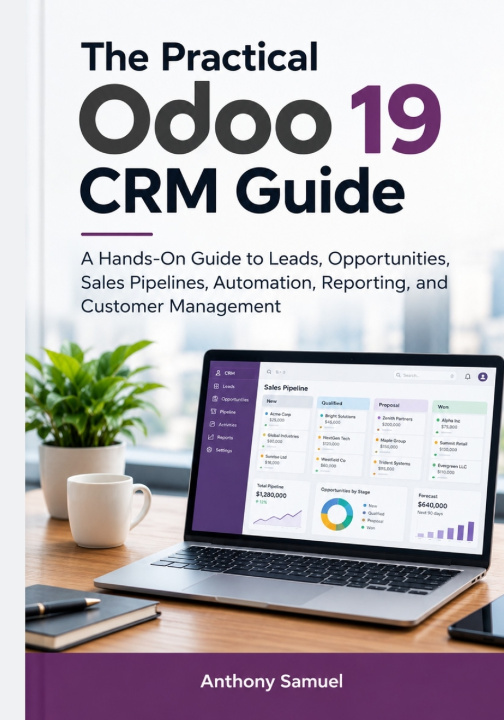
The Practical Odoo 19 CRM Guide
A Hands-On Guide to Leads, Opportunities, Sales Pipelines, Automation, Reporting, and Customer Management
 English
 70 b
70 b
 Coming soon
 New
New
Up to 30 days for returns

Build an Odoo 19 CRM that works in the real world-not just in a demonstration.
Odoo 19 provides powerful CRM capabilities for managing leads, opportunities, sales pipelines, activities, automation, and reporting. But having those features available does not automatically produce a CRM that salespeople will use, managers can trust, and developers can maintain.
The Practical Odoo 19 CRM Guide takes a hands-on, engineering-focused approach to designing and implementing a practical Odoo CRM.
Instead of simply explaining where to click, this book focuses on the reasoning behind CRM decisions and the production problems that appear after implementation.
You will learn how to:
• Design a lead process salespeople won't bypass
Define what a lead means, determine when it deserves sales attention, and create a qualification process that separates genuine opportunities from unproductive pipeline noise.
• Build a pipeline around real sales stages
Learn why stages should represent meaningful business states rather than simply tracking what a salesperson has done.
• Route work to the right people
Design ownership, sales-team, territory, availability, and skills-based routing without creating an unmaintainable maze of rules.
• Automate follow-up intelligently
Use activities, activity plans, scheduled processes, and custom automation where appropriate-while avoiding notification overload and automation that attempts to replace human sales judgment.
• Customize Odoo without creating a maintenance problem
Understand when standard configuration is enough, when lightweight customization makes sense, and when a custom module is actually justified.
• Integrate Odoo with the rest of the enterprise
Design integrations around business events, clear ownership, idempotency, retries, external identifiers, and failure handling instead of turning every CRM operation into another HTTP request.
• Build reporting that management can trust
Understand pipeline health, expected revenue, stage aging, lost reasons, forecasting, activity data, and the relationship between CRM data quality and meaningful reporting.
Throughout the book, practical scenarios expose the problems that rarely appear during an Odoo demonstration: stale opportunities, duplicate records, unclear ownership, noisy automation, unreliable qualification data, hard-coded business rules, fragile integrations, and dashboards that look impressive while telling the wrong story.
The emphasis is deliberately practical. You will see how CRM decisions affect salespeople, managers, developers, integrations, reporting, and long-term system maintenance.
Inside this book, you'll discover:
How to design a lead-to-opportunity lifecycle
How to define qualification without creating unnecessary bureaucracy
How to make pipeline stages represent real business states
How to design predictable ownership and routing
How to automate repetitive work without automating bad processes
How to test CRM workflows beyond the happy path
How to extend Odoo while keeping upgrades manageable
How to design reliable enterprise integrations
How to handle duplicate events, retries, and integration failures
How to identify stale and at-risk opportunities
How to distinguish useful CRM metrics from misleading numbers
How to create a CRM that can evolve as the business changes
Don't just configure the CRM. Engineer it.


About the book
English

Give this book today
It's easy
1 Add to cart and choose Deliver as present at the checkout 2 We'll send you a voucher 3 The book will arrive at the recipient's addressHi! I'm Libroamiko, your book advisor.
How can I help you?