
 Contact
 How to shop

Delivery
Shopping guide
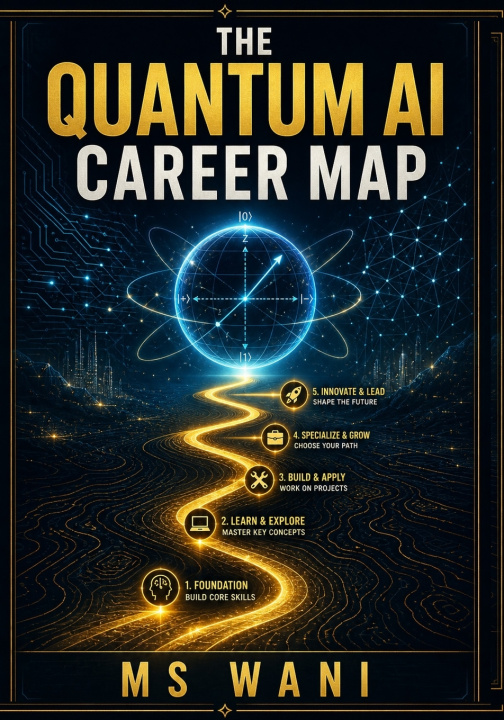
THE QUANTUM AI CAREER MAP
A Practical Roadmap Of Skills, Tools And Portfolio Projects To Launch An In-Demand Career In Quantum Computing And Machine Learning, Even If You Are Starting Today
 English
 45 b
 New
Up to 30 days for returns

Quantum Computing Is Hiring. But Nobody Has Told You What the Job Actually Looks Like.
Job titles change from one company to the next. Required skills contradict each other. Every headline either promises a quantum revolution tomorrow or calls the whole field hype. If you have ever wondered where you fit in, this guide gives you a clear, honest answer.
THE QUANTUM AI CAREER MAP is a practical roadmap for developers, data scientists, engineers, students and career changers who want to build real, provable skills in quantum computing and machine learning, without waiting for a perfect map or a PhD.
Written for developers, not physicists, it takes you from the first concepts to your first interview: the skills, the tools, a complete portfolio project and a job-search plan.
Inside this guide, you will learn how to:
- Separate quantum hype from reality, so you sound credible in any interview
- Learn the math you actually need (linear algebra, gates, measurement, complexity) through simple coding exercises
- Build the classical machine learning foundation every quantum team expects
- Understand quantum neural networks, quantum kernels, data embedding and barren plateaus
- Finish a full portfolio project in four weekends: a quantum kernel SVM benchmarked against a classical baseline
- Compare Qiskit, Cirq and PennyLane, and choose where to start
- Handle the NISQ era: noise, error mitigation, circuit compilation and benchmarking
- Prepare for the fault-tolerant future: logical qubits, surface codes and resource estimation
- Map the market: industries, employers, entry points, and how to evaluate a quantum company before you join
- Build a resume, GitHub portfolio and cold email that get replies, then follow a 12-week job-search plan
What makes this book different:
- Evidence over hype. Every chapter teaches you to build a baseline first and report honest results.
- Fieldwork in every chapter. You read, build, write and show your work, so you finish with real artifacts.
- Career-focused, not just theory. The book connects skills to projects, projects to a portfolio, and the portfolio to interviews.
- Built to last. The advice works whether quantum hardware matures sooner or later, because it builds portable skills in software, ML and communication.
- Primary sources. Each chapter points you to the original papers and documentation.
Who is this book for?
- Software developers and ML engineers moving into quantum
- Data scientists who want a path from classical to quantum AI
- STEM students and graduates planning their first role
- Physicists and mathematicians moving into industry
- Professionals changing careers into emerging technology
- Managers building or hiring for quantum teams
An honest note: this book does not promise an overnight job or claim that quantum will change everything next year. It gives you a method for building skills, proof of work and sound judgment that employers can verify.
Get the physical copy and start drawing your own map today.


About the book
English

Give this book today
It's easy
1 Add to cart and choose Deliver as present at the checkout 2 We'll send you a voucher 3 The book will arrive at the recipient's addressHi! I'm Libroamiko, your book advisor.
How can I help you?