
 Contact
 How to shop

Delivery
Shopping guide
 English
 75 b
 New
Up to 30 days for returns

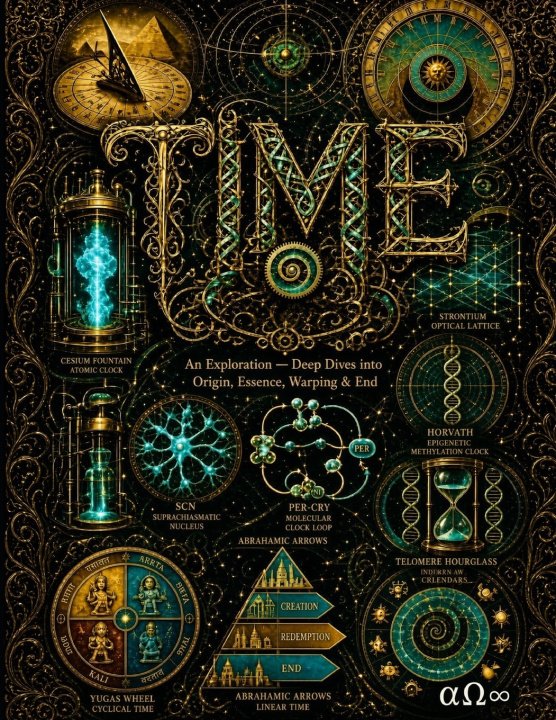
An Exploration of Time.
A new open exploration takes on one of the deepest questions in physics and refuses to simplify it away. Across 448 pages and 48 domains, it traces time from the Planck epoch - the first 10^-43 seconds after the beginning - to the heat death of the universe, and from the Wheeler-DeWitt equation, where time vanishes from the mathematics of everything, to the molecular clocks ticking inside human cells.
Written for readers with no physics background, the hard ideas arrive by comparison: time dilation becomes surfing a wave of spacetime. Entropy becomes a teenager's bedroom that never tidies itself. The Big Bang becomes not an explosion in space, but an explosion of space. Nothing is summarized away, every claim carries its sources, and the paradoxes are left standing exactly where physics left them.
Ancient Buddhist momentariness sits beside loop quantum cosmology. Proust's madeleine sits beside the neuroscience of memory. Hawking's chronology protection conjecture sits beside the 2026 laboratory experiments testing it.
Inside the seven books: the physics of time - relativity, quantum mechanics, and time's vanishing act in quantum gravity; the origin debates, from the Big Bounce to Penrose's conformal cyclic cosmology; the essence, from the Wheeler-DeWitt equation to Heidegger and Whitehead; black holes, where one event is finite for one observer and infinite for another; warp drives, wormholes, and closed timelike curves examined honestly, obstacles and all; and the living and cultural worlds - circadian clocks, the golden hour in medicine, Proust, Bergson, Heidegger, and why civilizations keep time so differently.
Written to be read by anyone: every technical term defined at first use, every difficult concept walked through step by step, every controversy presented with its critics fairly stated. Where physics is uncertain, the uncertainty is shown rather than hidden.


About the book
English

Give this book today
It's easy
1 Add to cart and choose Deliver as present at the checkout 2 We'll send you a voucher 3 The book will arrive at the recipient's addressHi! I'm Libroamiko, your book advisor.
How can I help you?