
 Contact
 Comment faire ses achats
Livraison
Guide d'achat
 Anglais
 9 b
9 b
Les clients ont également acheté

 /
/
 Livre relié
 25.02
€
25.02
€






 /
Livre de poche
46.21
€
/
Livre de poche
46.21
€
 /
Livre de poche
3.12
€
/
Livre de poche
3.12
€


 /
Livre relié
152.56
€
/
Livre relié
152.56
€

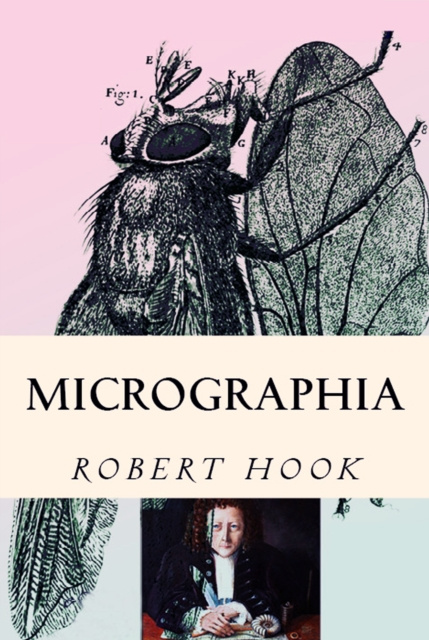
Micrographia is a historic book by Robert Hooke, detailing the then thirty-year-old Hooke's observations through various lenses. Published in September 1665, the first major publication of the Royal Society, it was the first scientific best-seller, inspiring a wide public interest in the new science of microscopy. It is also notable for coining the biological term cell.Observations: Hooke most famously describes a fly's eye and a plant cell (where he coined that term because plant cells, which are walled, reminded him of a monk's quarters). Known for its spectacular copperplate engravings of the miniature world, particularly its fold-out plates of insects, the text itself reinforces the tremendous power of the new microscope. The plates of insects fold out to be larger than the large folio itself, the engraving of the louse in particular folding out to four times the size of the book.Although the book is best known for demonstrating the power of the microscope, Micrographia also describes distant planetary bodies, the wave theory of light, the organic origin of fossils, and various other philosophical and scientific interests of its author.Publication: Published under the aegis of The Royal Society, the popularity of the book helped further the society's image and mission of being "e;the"e; scientifically progressive organization of London. Micrographia also focused attention on the miniature world, capturing the public's imagination in a radically new way. This impact is illustrated by Samuel Pepys' reaction upon completing the tome: "e;the most ingenious book that I ever read in my life."e;Hooke also selected several objects of human origin; among these objects were the jagged edge of a honed razor and the point of a needle, seeming blunt under the microscope. His goal may well have been as a way to contrast the flawed products of mankind with the perfection of nature (and hence, in the spirit of the times, of biblical creation).About Author:Robert Hooke (1635 - 1703) was an English natural philosopher, architect and polymath.His adult life comprised three distinct periods: as a scientific inquirer lacking money; achieving great wealth and standing through his reputation for hard work and scrupulous honesty following the great fire of 1666, but eventually becoming ill and party to jealous intellectual disputes. These issues may have contributed to his relative historical obscurity.He was at one time simultaneously the curator of experiments of the Royal Society and a member of its council, Gresham Professor of Geometry and a Surveyor to the City of London after the Great Fire of London, in which capacity he appears to have performed more than half of all the surveys after the fire. He was also an important architect of his time - though few of his buildings now survive and some of those are generally misattributed - and was instrumental in devising a set of planning controls for London whose influence remains today. Allan Chapman has characterised him as "e;England's Leonardo"e;.Robert Gunther's Early Science in Oxford, a history of science in Oxford during the Protectorate, Restoration and Age of Enlightenment, devotes five of its fourteen volumes to Hooke.Hooke studied at Wadham College during the Protectorate where he became one of a tightly knit group of ardent Royalists led by John Wilkins. Here he was employed as an assistant to Thomas Willis and to Robert Boyle, for whom he built the vacuum pumps used in Boyle's gas law experiments. He built some of the earliest Gregorian telescopes and observed the rotations of Mars and Jupiter. In 1665 he inspired the use of microscopes for scientific exploration with his book, Micrographia. Based on his microscopic observations of fossils, Hooke was an early proponent of biological evolution. He investigated the phenomenon of refraction, deducing the wave theory of light, and was the first to suggest that matter expands when heated and that air is made of small particles separated by relatively large distances. He performed pioneering work in the field of surveying and map-making and was involved in the work, though his plan for London on a grid system was rejected in favour of rebuilding along the existing routes.He also came near to an experimental proof that gravity follows an inverse square law, and hypothesised that such a relation governs the motions of the planets, an idea which was subsequently developed by Newton.


À propos du livre
Anglais

Offrez ce livre dès aujourd'hui
C’est simple
1 Ajouter au panier et choisir l'option Livrer comme cadeau à la caisse. 2 Nous vous enverrons un bon d'achat 3 Le livre arrivera à l'adresse du destinataireCeci pourrait également vous intéresser

 /
Livre de poche
49.84
€
/
Livre de poche
49.84
€
Bonjour ! Je suis Libroamiko, votre conseiller littéraire.
Comment puis-je vous aider ?