
 Contact
 Comment faire ses achats
Livraison
Guide d'achat
Modelling Protocells
The Emergent Synchronization of Reproduction and Molecular Replication
 Anglais
 209 b
209 b
Les clients ont également acheté



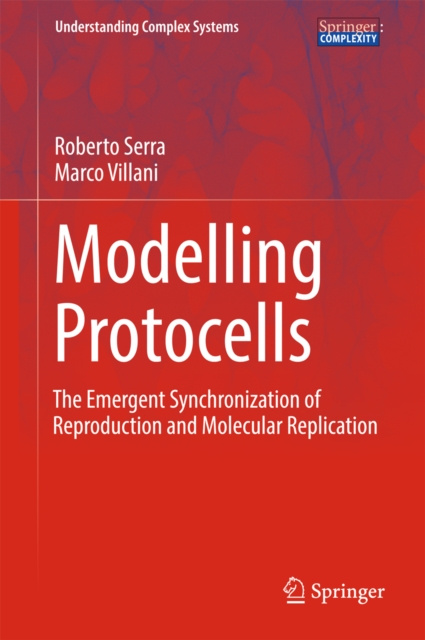
The monograph discusses models of synthetic protocells, which are cell-like structures obtained from non-living matter endowed with some rudimentary kind of metabolism and genetics, but much simpler than biological cells. They should grow and proliferate, generating offsprings that resemble in some way the parent protocells with some variation, so that selection may take place. Sustainable protocell populations have not yet been obtained experimentally and mathematical models are therefore extremely important to address key questions concerning their synthesis and behavior. Different protocell "e;architectures"e; have been proposed and high-level abstract models like those that are presented in this book are particularly relevant to gain a better understanding of the different properites. These models are able to treat all the major dynamical phenomena in a unified framework, so they can be seen as "e;virtual laboratories"e; for protocell research. Particular attention is paid to the problem of synchronization of the fission rate of the whole protocell and the duplication rate of its "e;protogenetic"e; material, which is shown to be an emergent property that spontaneously develops in successive generations.The book is of interest for a broad range of scientists working in soft matter physics, chemistry and biology, interested in the role protocells may play on the development of new technologies with medical, environmental and industrial applications as well as scientists interested in the origin of life.


À propos du livre
Anglais

Offrez ce livre dès aujourd'hui
C’est simple
1 Ajouter au panier et choisir l'option Livrer comme cadeau à la caisse. 2 Nous vous enverrons un bon d'achat 3 Le livre arrivera à l'adresse du destinataireCeci pourrait également vous intéresser
 /
/
 Livre relié
 102.93
€
102.93
€



Bonjour ! Je suis Libroamiko, votre conseiller littéraire.
Comment puis-je vous aider ?