
 Contact
 Comment faire ses achats

Livraison
Guide d'achat
Cellular Cause-Effect Structures
 Anglais
 373 b
Jusqu'à 30 jours pour les retours
Les clients ont également acheté

 /
 Livre
 57.76
€




















 /
Livre de poche
12.97
€


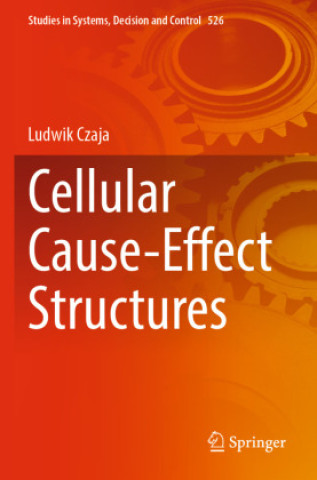
This book presents the adaptation of cause-effect structures to the formal description of phenomena such as the behaviour of living objects, the mutual communication of living cells, but also such as the growth of crystals and other natural processes. The system of cause-effect structures has been designed for the description and analysis of objects with dispersed components, acting concurrently and synchronizing and communicating one another. This adaptation consists in customizing generic semantics of cause-effect structures to semantics specific to the behaviour of natural objects. That is creating evolution rules for the formal models of these objects. However, the structural, algebraic properties of cause-effect structures are retained. The activity of cellular cause-effect structures is supposed to imitate the activity of cellular automata, the formal system intended for the above-mentioned aims. But operations on syntactic constructions, in particular their transformations and simplification, are the same as for the general cause-effect structures. These algebraic operations are also used to perform certain geometric/topological conversions of location bases for the cellular cause-effect structures, like flat surfaces into cylindrical or toroidal. This is depicted by numerous illustrations. An adaptation of cause-effect structures to other formal descriptions of some natural phenomena, such as reaction systems, is provided in book 331 of the "Lecture Notes in Networks and Systems" series, whereas the complete description of cause-effect structures, in book 45.


À propos du livre
Anglais

Offrez ce livre dès aujourd'hui
C’est simple
1 Ajouter au panier et choisir l'option Livrer comme cadeau à la caisse. 2 Nous vous enverrons un bon d'achat 3 Le livre arrivera à l'adresse du destinataireCeci pourrait également vous intéresser






 /
Livre de poche
23.64
€
 /
Livre de poche
24.55
€

 /
Livre de poche
19.71
€
 /
Livre relié
119.35
€














Bonjour ! Je suis Libroamiko, votre conseiller littéraire.
Comment puis-je vous aider ?