
 Contact
 Comment faire ses achats
Livraison
Guide d'achat
Database Application Engineering with DAIDA
 Anglais
 249 b
249 b
Jusqu'à 30 jours pour les retours
Les clients ont également acheté
















 /
/
 Livre de poche
 16.43
€
16.43
€



 /
Livre de poche
13.81
€
/
Livre de poche
13.81
€



 /
Livre de poche
52.94
€
/
Livre de poche
52.94
€




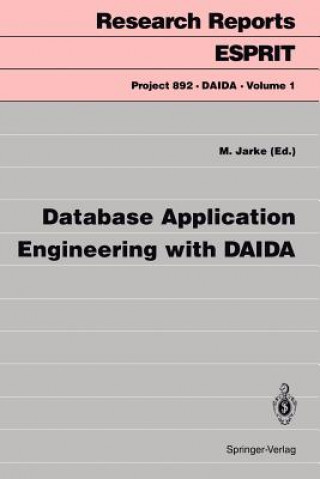
§Der Band berichtet über das ESPRIT-Projekt DAIDA (Entwicklungsunterstützung für intelligente Datenbankanwendungen), in dem ein Prototyp einer umfassenden Informationssystem-Umgebung erstellt wurde. Dabei unterstützen Sprachen, Methoden und Werkzeuge den gesamten Prozeß der Entwicklung und Wartung von Informationssystemen. The development of integrated environments for computer-assisted software engineering (CASE) has proven more difficult than expected. The ESPRIT project DAIDA (Advanced Interactive Development of Data-Intensive Applications) has produced the first prototype of a comprehensive systems environment which manages the whole process of information systems development and maintenance as a multi-layered knowledge base with semi-automatic mapping between the layers. Several DAIDA results have had substantial impact on systems development theory and practice: §The language Telos and its usage in the ConceptBase system for modeling knowledge about information systems, the modular database programming language DBPL as a theoretical foundation for future object-oriented databases, the integration of knowledge-based analysis and mapping assistants from requirements capture to running code, and a CAD metamodel of information systems processes including support for configuration management and teamwork. The example of a personnel information system is used throughout the book to illustrate the relationships between the different languages, methods, and tools. The book has three main parts, covering "upper CASE" (requirements analysis and its mapping to initial designs), "lower CASE" (transformation of designs into efficient database programs), and process management. §In addition to direct DAIDA results, the book contains contributions from collaborating national and North American projects. The intended audience for the book are practitioners, researchers, and graduate students with an interest in CASE integration for data-intensive information systems.


À propos du livre
Anglais
Catégories

Offrez ce livre dès aujourd'hui
C’est simple
1 Ajouter au panier et choisir l'option Livrer comme cadeau à la caisse. 2 Nous vous enverrons un bon d'achat 3 Le livre arrivera à l'adresse du destinataireCeci pourrait également vous intéresser

 /
Livre relié
43.77
€
/
Livre relié
43.77
€


 /
Livre de poche
23.69
€
/
Livre de poche
23.69
€
 /
Livre de poche
31.96
€
/
Livre de poche
31.96
€






 /
Livre relié
35.80
€
/
Livre relié
35.80
€



 /
Livre relié
53.25
€
/
Livre relié
53.25
€








Bonjour ! Je suis Libroamiko, votre conseiller littéraire.
Comment puis-je vous aider ?