Contact
 Comment faire ses achats
Livraison
Guide d'achat
 Anglais
 373 b
373 b
Jusqu'à 30 jours pour les retours
Les clients ont également acheté

 /
/
 Livre de poche
 39.31
€
39.31
€







 /
Livre de poche
9.41
€
/
Livre de poche
9.41
€





 /
Livre de poche
42.86
€
/
Livre de poche
42.86
€
 /
Livre de poche
17.12
€
/
Livre de poche
17.12
€

 /
Livre de poche
16.21
€
/
Livre de poche
16.21
€






 /
Livre de poche
11.95
€
/
Livre de poche
11.95
€

 /
Livre de poche
21.37
€
/
Livre de poche
21.37
€




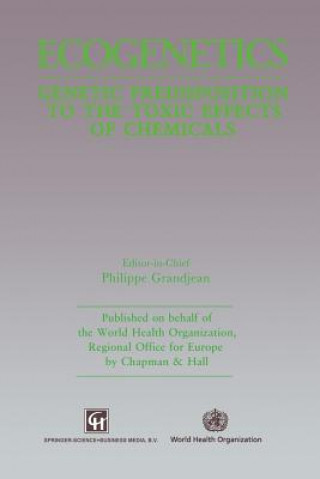
Protection of human health by prevention of environmental hazards has become a major concern in all European countries. This concern is reflected in the regional strategy of Health for All by the Year 2000, as developed in 1984, and in the 1989 European Charter on Environment and Health. However, despite considerable progress, most efforts are related to single sources of exposure and to a small number of 'priority' chemicals. In protecting the population against chemical hazards, attention must also be paid to the fact that subgroups are particularly susceptible to the adverse effects of certain chemicals. This hypersusceptibility may be genetically determined. Such individual predisposition to toxic effects must be taken into account in the efforts to prevent adverse effects of environmental exposures to toxic chemicals. To help address these problems the Regional Office, in co-operation with the Institute of Human Genetics and Anthropology of the Univer sity of Dusseldorf and with financial support from the Federal Ministry for the Environment, Nature Conservation and Nuclear Safety of the Federal Republic of Germany, organized a consultation in Krefeld in October 1989. The meeting was attended by 17 experts from 12 coun tries, three representatives of the host government, two representatives of other organizations and five staff members from the WHO Regional Office for Europe and WHO Headquarters. The list of participants is included as an appendix to the present volume.


À propos du livre
Anglais

Offrez ce livre dès aujourd'hui
C’est simple
1 Ajouter au panier et choisir l'option Livrer comme cadeau à la caisse. 2 Nous vous enverrons un bon d'achat 3 Le livre arrivera à l'adresse du destinataireCeci pourrait également vous intéresser
 /
Livre de poche
206.13
€
/
Livre de poche
206.13
€










 /
Livre relié
197.31
€
/
Livre relié
197.31
€






 /
Livre de poche
21.58
€
/
Livre de poche
21.58
€


 /
Livre de poche
206.13
€
/
Livre de poche
206.13
€