
 Contact
 Comment faire ses achats
Livraison
Guide d'achat
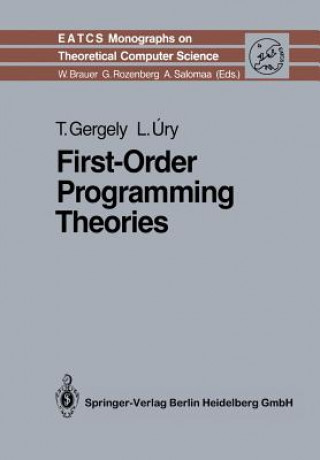
First-Order Programming Theories
 Anglais
 249 b
249 b
Jusqu'à 30 jours pour les retours
Les clients ont également acheté







 /
/
 Livre relié
 13.55
€
13.55
€








 /
Livre de poche
35.71
€
/
Livre de poche
35.71
€






This book proposes a purely classical first-order logical approach to the theory of programming. The authors, leading members of the famous "Hungarian school", use this approach to give a unified and systematic presentation of the theory. This approach provides formal methods and tools for reasoning about computer programs and programming languages by allowing the syntactic and semantic characterization of programs, the description of program properties, and ways to check whether a given program satisfies certain properties. The basic methods are logical extension, inductive definition and their combination, all of which admit an appropriate first-order representation of data and time. The framework proposed by the authors allows the investigation and development of different programming theories and logics from a unified point of view. Dynamic and temporal logics, for example, are investigated and compared with respect to their expressive and proof-theoretic powers. The book should appeal to both theoretical researchers and students. For researchers in computer science the book provides a coherent presentation of a new approach which permits the solution of various problems in programming theory in a unified manner by the use of first-order logical tools. The book may serve as a basis for graduate courses in programming theory and logic as it covers all important questions arising between the theory of computation and formal descriptive languages and presents an appropriate derivation system.


À propos du livre
Anglais

Offrez ce livre dès aujourd'hui
C’est simple
1 Ajouter au panier et choisir l'option Livrer comme cadeau à la caisse. 2 Nous vous enverrons un bon d'achat 3 Le livre arrivera à l'adresse du destinataireCeci pourrait également vous intéresser





 /
Livre de poche
23.77
€
/
Livre de poche
23.77
€




 /
Livre de poche
24.98
€
/
Livre de poche
24.98
€
 /
Livre de poche
42.69
€
/
Livre de poche
42.69
€
Bonjour ! Je suis Libroamiko, votre conseiller littéraire.
Comment puis-je vous aider ?