
 Contact
 Comment faire ses achats

Livraison
Guide d'achat
Fixed Interval Smoothing for State Space Models
 Anglais
 288 b
Jusqu'à 30 jours pour les retours
Les clients ont également acheté




 /
 Livre de poche
 21.92
€

 /
Livre de poche
16.69
€



 /
Livre de poche
16.08
€


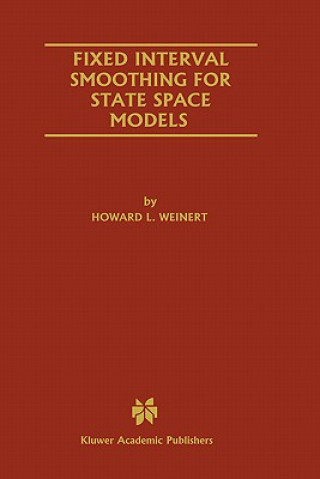
Fixed-interval smoothing is a method of extracting useful information from inaccurate data. It has been applied to problems in engineering, the physical sciences, and the social sciences, in areas such as control, communications, signal processing, acoustics, geophysics, oceanography, statistics, econometrics, and structural analysis. This monograph addresses problems for which a linear stochastic state space model is available, in which case the objective is to compute the linear least-squares estimate of the state vector in a fixed interval, using observations previously collected in that interval. The author uses a geometric approach based on the method of complementary models. Using the simplest possible notation, he presents straightforward derivations of the four types of fixed-interval smoothing algorithms, and compares the algorithms in terms of efficiency and applicability. Results show that the best algorithm has received the least attention in the literature. Fixed Interval Smoothing for State Space Models: includes new material on interpolation, fast square root implementations, and boundary value models; is the first book devoted to smoothing; contains an annotated bibliography of smoothing literature; uses simple notation and clear derivations; compares algorithms from a computational perspective; identifies a best algorithm. Fixed Interval Smoothing for State Space Models will be the primary source for those wanting to understand and apply fixed-interval smoothing: academics, researchers, and graduate students in control, communications, signal processing, statistics and econometrics.


À propos du livre
Anglais

Offrez ce livre dès aujourd'hui
C’est simple
1 Ajouter au panier et choisir l'option Livrer comme cadeau à la caisse. 2 Nous vous enverrons un bon d'achat 3 Le livre arrivera à l'adresse du destinataireCeci pourrait également vous intéresser







 /
Livre de poche
17.89
€








Bonjour ! Je suis Libroamiko, votre conseiller littéraire.
Comment puis-je vous aider ?