
 Contact
 Comment faire ses achats
Livraison
Guide d'achat
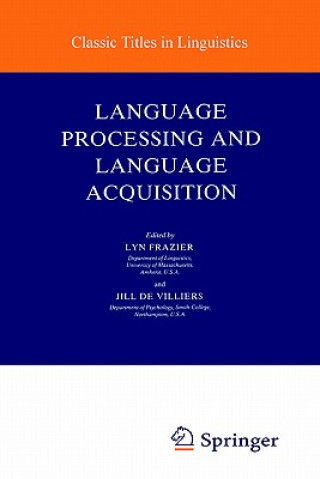
Language Processing and Language Acquisition
 Anglais
 498 b
498 b
Jusqu'à 30 jours pour les retours
Les clients ont également acheté



 /
/
 Livre relié
 11.83
€
11.83
€









 /
Livre de poche
84.96
€
/
Livre de poche
84.96
€




Studies of language acqUiSItion have largely ignored processing prin ciples and mechanisms. Not surprisingly, questions concerning the analysis of an informative linguistic input - the potential evidence for grammatical parameter setting - have also been ignored. Especially in linguistic approaches to language acquisition, the role of language processing has not been prominent. With few exceptions (e. g. Goodluck and Tavakolian, 1982; Pinker, 1984) discussions of language perform ance tend to arise only when experimental debris, the artifact of some experiment, needs to be cleared away. Consequently, language pro cessing has been viewed as a collection of rather uninteresting perform ance factors obscuring the true object of interest, namely, grammar acquisition. On those occasions when parsing "strategies" have been incorporated into accounts of language development, they have often been discussed as vague preferences, not open to rigorous analysis. In principle, however, theories of language comprehension can and should be subjected to the same criteria of explicitness and explanatoriness as other theories, e. g. , theories of grammar. Thus their peripheral role in accounts of language development may reflect accidental factors, rather than any inherent fuzziness or irrelevance to the language acquisition problem. It seems probable that an explicit model of the way(s) processing routines are applied in acquisition would help solve some central problems of grammar acquisition, since these routines regulate the application of grammatical knowledge to novel inputs.


À propos du livre
Anglais

Offrez ce livre dès aujourd'hui
C’est simple
1 Ajouter au panier et choisir l'option Livrer comme cadeau à la caisse. 2 Nous vous enverrons un bon d'achat 3 Le livre arrivera à l'adresse du destinataireCeci pourrait également vous intéresser

 /
Livre de poche
12.13
€
/
Livre de poche
12.13
€
 /
Livre de poche
38.23
€
/
Livre de poche
38.23
€



 /
Livre de poche
11.52
€
/
Livre de poche
11.52
€






 /
Livre de poche
13.95
€
/
Livre de poche
13.95
€
 /
Livre de poche
13.04
€
/
Livre de poche
13.04
€



 /
Livre de poche
185.11
€
/
Livre de poche
185.11
€






Bonjour ! Je suis Libroamiko, votre conseiller littéraire.
Comment puis-je vous aider ?