
 Contact
 Comment faire ses achats
Livraison
Guide d'achat
Last Steps
 Anglais
 109 b
109 b
Jusqu'à 30 jours pour les retours
Les clients ont également acheté


 /
/
 Livre de poche
 14.27
€
14.27
€

 /
Livre de poche
34.32
€
/
Livre de poche
34.32
€


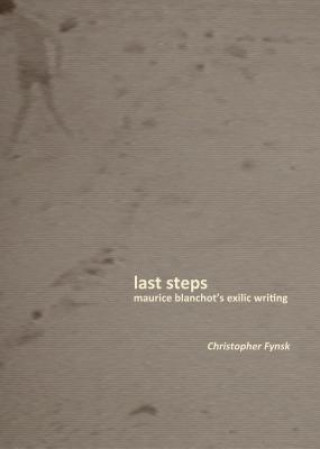
Writing, Maurice Blanchot taught us, is not something that is in one's power. It is, rather, a search for a non-power that refuses mastery, order, and all established authority. For Blanchot, this search was guided by an enigmatic exigency, an arresting rupture, and a promise of justice that required endless contestation of every usurping authority, an endless going out toward the other. "The step/not beyond" ("le pas au-del?") names this exilic passage as it took form in his influential later work, but not as a theme or concept, since its "step" requires a transgression of discursive limits and any grasp afforded by the labour of the negative. Thus, to follow "the step/not beyond" is to follow a kind of event in writing, to enter a movement that is never quite captured in any defining or narrating account. Last Steps attempts a practice of reading that honours the exilic exigency even as it risks drawing Blanchot's reflective writings and fragmentary narratives into the articulation of a reading. It brings to the fore Blanchot's exceptional contributions to contemporary thought on the ethico-political relation, language, and the experience of human finitude. It offers the most sustained interpretation of The Step Not Beyond available, with attentive readings of a number of major texts, as well as chapters on Levinas and Blanchot's relation to Judaism. Its trajectory of reading limns the meaning of a question from The Infinite Conversation that implies an opening and a singular affirmation rather than a closure: "How had he come to will the interruption of the discourse?"


À propos du livre
Anglais

Offrez ce livre dès aujourd'hui
C’est simple
1 Ajouter au panier et choisir l'option Livrer comme cadeau à la caisse. 2 Nous vous enverrons un bon d'achat 3 Le livre arrivera à l'adresse du destinataireCeci pourrait également vous intéresser









Bonjour ! Je suis Libroamiko, votre conseiller littéraire.
Comment puis-je vous aider ?