
 Contact
 Comment faire ses achats
Livraison
Guide d'achat
 Anglais
 373 b
373 b
Jusqu'à 30 jours pour les retours
Ceci pourrait également vous intéresser


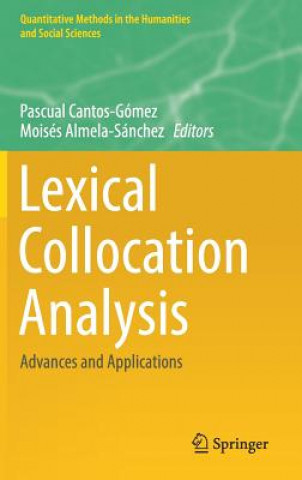
This book re-examines the notion of word associations, more precisely collocations. It attempts to come to a potentially more generally applicable definition of collocation and how to best extract, identify and measure collocations. The book highlights the role played by (i) automatic linguistic annotation (part-of-speech tagging, syntactic parsing, etc.), (ii) using semantic criteria to facilitate the identification of collocations, (iii) multi-word structured, instead of the widespread assumption of bipartite collocational structures, for capturing the intricacies of the phenomenon of syntagmatic attraction, (iv) considering collocation and valency as near neighbours in the lexis-grammar continuum and (v) the mathematical properties of statistical association measures in the automatic extraction of collocations from corpora. This book is an ideal guide to the use of statistics in collocation analysis and lexicography, as well as a practical text to the development of skills in the application of computational lexicography. Lexical Collocation Analysis: Advances and Applications begins with an examination of how automatic linguistic annotation can improve collocation identification and what annotation levels are most beneficial, comparing various parsers and parsing schemes through the use of Universal Dependencies. Next, the book describes an automatic collocation-identification technique based on information extracted from dictionary definitions. This approach aims to distinguish and decide whether a node/base and collocate is a free combinations or a phrases, based on purely statistical criteria. Chapter 3 introduces and validates a new bottom-up approach to the identification/extraction of multi-word expressions in corpora. It is based on the successive combination of bigrams to form word sequences of various lengths. Chapter 4 explores the use of collocation networks in discourse analysis, language learning and lexicography. Chapter 5 presents a proposal for refining the methods of semantic description based on corpus collocational data. Finally the book concludes with an argument in favor of not regarding collocation and valency as strictly discrete categories but rather seeing them as near neighbours in the lexis-grammar continuum.


À propos du livre
Anglais

Offrez ce livre dès aujourd'hui
C’est simple
1 Ajouter au panier et choisir l'option Livrer comme cadeau à la caisse. 2 Nous vous enverrons un bon d'achat 3 Le livre arrivera à l'adresse du destinataireBonjour ! Je suis Libroamiko, votre conseiller littéraire.
Comment puis-je vous aider ?