Contact
 Comment faire ses achats
Livraison
Guide d'achat
 Anglais
 125 b
125 b
Jusqu'à 30 jours pour les retours
Les clients ont également acheté
















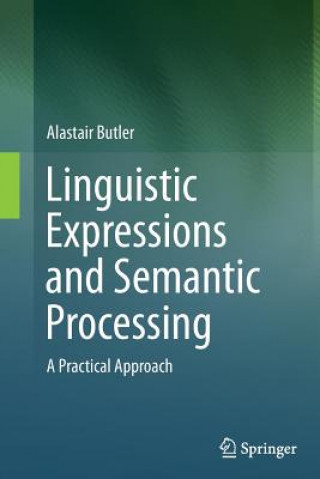
This book introduces formal semantics techniques for a natural language processing audience. Methods discussed involve: (i) the denotational techniques used in model-theoretic semantics, which make it possible to determine whether a linguistic expression is true or false with respect to some model of the way things happen to be; and (ii) stages of interpretation, i.e., ways to arrive at meanings by evaluating and converting source linguistic expressions, possibly with respect to contexts, into output (logical) forms that could be used with (i). The book demonstrates that the methods allow wide coverage without compromising the quality of semantic analysis. Access to unrestricted, robust and accurate semantic analysis is widely regarded as an essential component for improving natural language processing tasks, such as: recognizing textual entailment, information extraction, summarization, automatic reply, and machine translation.


À propos du livre
Anglais

Offrez ce livre dès aujourd'hui
C’est simple
1 Ajouter au panier et choisir l'option Livrer comme cadeau à la caisse. 2 Nous vous enverrons un bon d'achat 3 Le livre arrivera à l'adresse du destinataireCeci pourrait également vous intéresser
 /
/
 Livre de poche
 106.75
€
106.75
€




 /
Livre de poche
50.88
€
/
Livre de poche
50.88
€