
 Contact
 Comment faire ses achats
Livraison
Guide d'achat
Methods for Handling Imperfect Spatial Information
 Anglais
 373 b
373 b
Jusqu'à 30 jours pour les retours
Les clients ont également acheté

















 /
/
 Livre de poche
 42.76
€
42.76
€


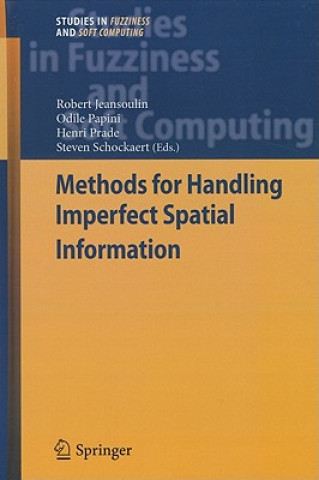
Spatial information is pervaded by uncertainty. Indeed, geographical data is often obtained by an imperfect interpretation of remote sensing images, while people attach ill-defined or ambiguous labels to places and their properties. As another example, medical images are often the result of measurements by imprecise sensors (e.g. MRI scans). Moreover, by processing spatial information in real-world applications, additional uncertainty is introduced, e.g. due to the use of interpolation/extrapolation techniques or to conflicts that are detected in an information fusion step. §To the best of our knowledge, this book presents the first overview of spatial uncertainty which goes beyond the setting of geographical information systems. Uncertainty issues are especially addressed from a representation and reasoning point of view. In particular, the book consists of 14 chapters, which are clustered around three central topics. The first of these topics is about the uncertainty in meaning of linguistic descriptions of spatial scenes. Second, the issue of reasoning about spatial relations and dealing with inconsistency in information merging is studied. Finally, interpolation and prediction of spatial phenomena are investigated, both at the methodological level and from an application-oriented perspective. The concept of uncertainty by itself is understood in a broad sense, including both quantitative and more qualitative approaches, dealing with variability, epistemic uncertainty, as well as with vagueness of terms.


À propos du livre
Anglais

Offrez ce livre dès aujourd'hui
C’est simple
1 Ajouter au panier et choisir l'option Livrer comme cadeau à la caisse. 2 Nous vous enverrons un bon d'achat 3 Le livre arrivera à l'adresse du destinataireCeci pourrait également vous intéresser















 /
Livre de poche
11.11
€
/
Livre de poche
11.11
€








 /
Livre de poche
28.20
€
/
Livre de poche
28.20
€
Bonjour ! Je suis Libroamiko, votre conseiller littéraire.
Comment puis-je vous aider ?