
 Contact
 Comment faire ses achats

Livraison
Guide d'achat
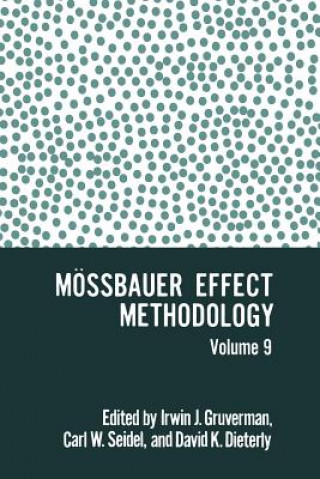
Moessbauer Effect Methodology
 Anglais
 125 b
Jusqu'à 30 jours pour les retours
Les clients ont également acheté

 /
 Livre de poche
 65.79
€

 /
Livre de poche
26.78
€




 /
Livre de poche
25.77
€






 /
Livre de poche
43.30
€
 /
Livre de poche
15.20
€


 /
Livre de poche
33.83
€



 /
Livre de poche
44.00
€



This is the ninth volume of a continuing series intended to provide a forum for publication of develop ments in Mossbauer effect methodology and in spectroscopy and its applications. Mossbauer Effect Methodology, Volume 9, records the proceedings of the Ninth Symposium on Mossbauer Effect Methodology. The symposium was sponsored by the New England Nuclear Corporation and interest was concentrated on spectroscopy and applications, with more than usual emphasis on new methodology. The symposium was held in the Palmer House in Chicago on February 3, 1974. Dr. Stanley Hanna presided over the afternoon and evening sessions. Attendance was lower than usual; about one hundred participants were present. This may reflect the continu ing pressure of travel budget limitations. Contributing Sponsors were Austin Science Associates, El Scint, Inc., Nuclear Science Instruments and Ranger Electronics. These organizations demonstrated their products for Mossbauer applications. The continuing improvements in the spectrometers and their adjuncts was evident. The Selection Committee again had a most difficult task, and was obliged to accept only about half of the submitted papers. A most interesting group of papers on applications and spectroscopy featured reports on electronic relaxation phenomena, magnetic phase and spin transformations, photochromism in strontium titanate, lattice studies, and phase determination by Kossel analysis. The excellent methodology session included presentations on data analysis techniques for spectral folding, hyperfine interaction analysis and recoil-free fraction measurement, a backscatter spectrometer and a report on a Selective Excitation Double Mossbauer method to study time-dependent phenomena.


À propos du livre
Anglais
Catégories

Offrez ce livre dès aujourd'hui
C’est simple
1 Ajouter au panier et choisir l'option Livrer comme cadeau à la caisse. 2 Nous vous enverrons un bon d'achat 3 Le livre arrivera à l'adresse du destinataireCeci pourrait également vous intéresser










 /
Livre relié
18.53
€








 /
Livre de poche
33.33
€



 /
Livre de poche
20.64
€
Bonjour ! Je suis Libroamiko, votre conseiller littéraire.
Comment puis-je vous aider ?