
 Contact
 Comment faire ses achats
Livraison
Guide d'achat
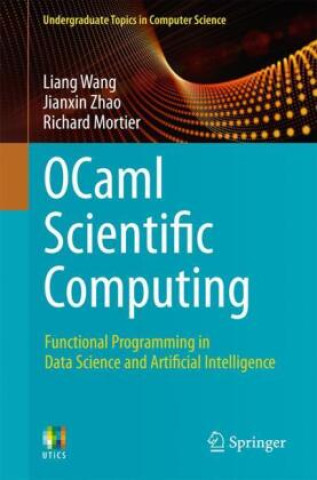
OCaml Scientific Computing
Functional Programming in Data Science and Artificial Intelligence
 Anglais
 89 b
89 b
Politique de retour sous 30 jours
Les clients ont également acheté
 /
/
 Livre de poche
 15.58
€
15.58
€
















 /
Livre de poche
26.22
€
/
Livre de poche
26.22
€



 /
Livre de poche
24.19
€
/
Livre de poche
24.19
€



This book is about the harmonious synthesis of functional programming and numerical computation. It shows how the expressiveness of OCaml allows for fast and safe development of data science applications. Step by step, the authors build up to use cases drawn from many areas of Data Science, Machine Learning, and AI, and then delve into how to deploy at scale, using parallel, distributed, and accelerated frameworks to gain all the advantages of cloud computing environments.To this end, the book is divided into three parts, each focusing on a different area. Part I begins by introducing how basic numerical techniques are performed in OCaml, including classical mathematical topics (interpolation and quadrature), statistics, and linear algebra. It moves on from using only scalar values to multi-dimensional arrays, introducing the tensor and Ndarray, core data types in any numerical computing system. It concludes with two more classical numerical computing topics, the solution of Ordinary Differential Equations (ODEs) and Signal Processing, as well as introducing the visualization module we use throughout this book. Part II is dedicated to advanced optimization techniques that are core to most current popular data science fields. We do not focus only on applications but also on the basic building blocks, starting with Algorithmic Differentiation, the most crucial building block that in turn enables Deep Neural Networks. We follow this with chapters on Optimization and Regression, also used in building Deep Neural Networks. We then introduce Deep Neural Networks as well as topic modelling in Natural Language Processing (NLP), two advanced and currently very active fields in both industry and academia. Part III collects a range of case studies demonstrating how you can build a complete numerical application quickly from scratch using Owl. The cases presented include computer vision and recommender systems. This book aims at anyone with a basic knowledge of functional programming and a desire to explore the world of scientific computing, whether to generally explore the field in the round, to build applications for particular topics, or to deep-dive into how numerical systems are constructed. It does not assume strict ordering in reading - readers can simply jump to the topic that interests them most.


À propos du livre
Anglais

Offrez ce livre dès aujourd'hui
C’est simple
1 Ajouter au panier et choisir l'option Livrer comme cadeau à la caisse. 2 Nous vous enverrons un bon d'achat 3 Le livre arrivera à l'adresse du destinataireCeci pourrait également vous intéresser







 /
Livre relié
35.53
€
/
Livre relié
35.53
€





 /
Livre de poche
21.25
€
/
Livre de poche
21.25
€






Bonjour ! Je suis Libroamiko, votre conseiller littéraire.
Comment puis-je vous aider ?