
 Contact
 Comment faire ses achats
Livraison
Guide d'achat
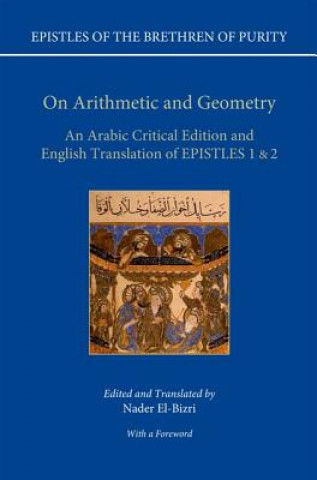
On Arithmetic & Geometry
An Arabic Critical Edition and English Translation of Epistles 1-2
 Anglais
 202 b
202 b
Jusqu'à 30 jours pour les retours
Les clients ont également acheté





 /
/
 Livre de poche
 10.07
€
10.07
€


The Ikhwan al-Safa' (Brethren of Purity), the anonymous adepts of a tenth-century esoteric fraternity based in Basra and Baghdad, hold an eminent position in the history of science and philosophy in Islam due to the wide reception and assimilation of their monumental encyclopaedia, the Rasa 'il Ikhwan al-Safa' (Epistles of the Brethren of Purity). The fifty-two epistles offer synoptic accounts of the classical sciences of the age, treating themes in mathematics, logic, natural philosophy, psychology, metaphysics, and theology, in addition to didactic fables. The Rasa 'il constitutes a paradigmatic legacy in the canonization of philosophy and the sciences in mediaeval Islamic civilization, and has also shown a permeating influence in Western culture. This volume is the fifth of the series, consisting of the first critical edition of the Rasa 'il in its original Arabic, complete with the fully annotated English translation. Prepared by Dr Nader El-Bizri, Epistles 1 and 2 (on arithmetic and geometry) present technical and epistemic analyses of mathematical concepts and their metaphysical underpinnings, in terms of investigating the properties of numbers and of geometric magnitudes, based primarily on the traditions of Nicomachus of Geresa and of Euclid as interpreted by the Ikhwan. With a Pythagorean construal of the ultimate principles of mathematics within the symbolic order of mysticism, and inspired by their own ontological outlook on the articles of faith in Islam, the Ikhwan view arithmetic and geometry through a monotheistic spiritual lens. This informed their treatment of mathematical knowledge, in pedagogic and heuristic terms, as part of the essential disciplines of the quadrivium, which aimed at preparing novices to study logic, then sciences of nature and the soul, before graduating to the lofty topics of theology and metaphysics. The volume also provides an overview of the mathematical sciences within the Islamic intellectual milieu, and of the tenth-century urban culture of Mesopotamian and Syrian locales.


À propos du livre
Anglais
Catégories

Offrez ce livre dès aujourd'hui
C’est simple
1 Ajouter au panier et choisir l'option Livrer comme cadeau à la caisse. 2 Nous vous enverrons un bon d'achat 3 Le livre arrivera à l'adresse du destinataireCeci pourrait également vous intéresser








 /
Livre de poche
20.05
€
/
Livre de poche
20.05
€










 /
/
 DVD
17.12
€
DVD
17.12
€



Bonjour ! Je suis Libroamiko, votre conseiller littéraire.
Comment puis-je vous aider ?