
 Contact
 Comment faire ses achats
Livraison
Guide d'achat
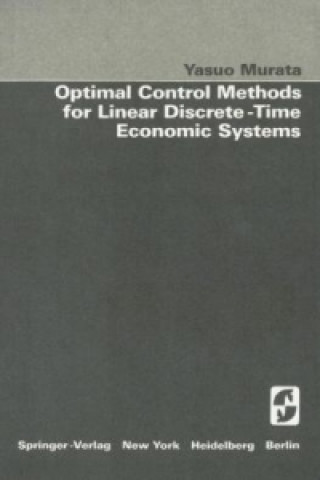
Optimal Control Methods for Linear Discrete-Time Economic Systems
 Anglais
 220 b
220 b
Jusqu'à 30 jours pour les retours
Les clients ont également acheté

 /
/
 Livre de poche
 39.43
€
39.43
€






 /
Livre de poche
11.27
€
/
Livre de poche
11.27
€

 /
/
 Calendrier
19.71
€
Calendrier
19.71
€
 /
/
 CD Audio
28.65
€
CD Audio
28.65
€











 /
Livre relié
79.37
€
/
Livre relié
79.37
€


As our title reveals, we focus on optimal control methods and applications relevant to linear dynamic economic systems in discrete-time variables. We deal only with discrete cases simply because economic data are available in discrete forms, hence realistic economic policies should be established in discrete-time structures. Though many books have been written on optimal control in engineering, we see few on discrete-type optimal control. More over, since economic models take slightly different forms than do engineer ing ones, we need a comprehensive, self-contained treatment of linear optimal control applicable to discrete-time economic systems. The present work is intended to fill this need from the standpoint of contemporary macroeconomic stabilization. The work is organized as follows. In Chapter 1 we demonstrate instru ment instability in an economic stabilization problem and thereby establish the motivation for our departure into the optimal control world. Chapter 2 provides fundamental concepts and propositions for controlling linear deterministic discrete-time systems, together with some economic applica tions and numerical methods. Our optimal control rules are in the form of feedback from known state variables of the preceding period. When state variables are not observable or are accessible only with observation errors, we must obtain appropriate proxies for these variables, which are called "observers" in deterministic cases or "filters" in stochastic circumstances. In Chapters 3 and 4, respectively, Luenberger observers and Kalman filters are discussed, developed, and applied in various directions. Noticing that a separation principle lies between observer (or filter) and controller (cf.


À propos du livre
Anglais

Offrez ce livre dès aujourd'hui
C’est simple
1 Ajouter au panier et choisir l'option Livrer comme cadeau à la caisse. 2 Nous vous enverrons un bon d'achat 3 Le livre arrivera à l'adresse du destinataireCeci pourrait également vous intéresser
 /
Livre de poche
32.21
€
/
Livre de poche
32.21
€
 /
Livre de poche
16.76
€
/
Livre de poche
16.76
€

 /
Livre de poche
8.12
€
/
Livre de poche
8.12
€
 /
Livre de poche
21.23
€
/
Livre de poche
21.23
€











 /
Livre relié
30.89
€
/
Livre relié
30.89
€