
 Contact
 Comment faire ses achats
Livraison
Guide d'achat
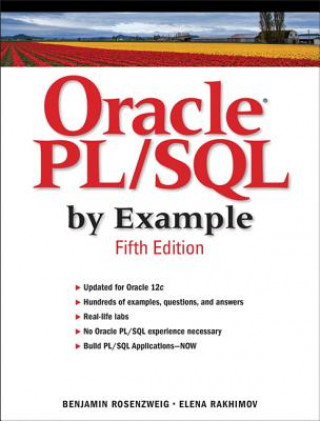
Oracle PL/SQL by Example
 Anglais
 141 b
141 b
Jusqu'à 30 jours pour les retours
Les clients ont également acheté




























Like the previous edition, this tutorial is an integrated learning solution that teaches all the Oracle PL/SQL skills you need, hands-on, through real-world labs, extensive examples, exercises, and projects. Completely updated for Oracle 12c, it covers all the fundamentals, from PL/SQL syntax and program control through packages and optimization. This book's approach reflects the authors' award-winning experience teaching PL/SQL programming to professionals. Providing readers with the accompanying schema that can be used for practice allows the authors to explain PL/SQL concepts through examples. Each concept is explained first, then illustrated via examples and interactive labs that introduce topics about Oracle PL/SQL. The topics are discussed briefly and then explored through exercises. Each exercise consists of a series of steps followed to perform a specific task, along with questions designed to help you discover the important things about PL/SQL programming on your own. The answers to the questions are then given with more in-depth discussion of the topics. In this way the answers are not just solutions to the exercises but a continuation of the learning process. The exercises are intended to act as your guide to walk you through a particular task. Finally, at the end of each chapter there is a "Test Your Thinking" section made up of a series of projects designed to solidify all of the skills learned in the chapter. Key topics covered include: * Using conditional and iterative program control techniques, including the new CONTINUE and CONTINUE WHEN statements * Efficiently handling errors and exceptions * Using stored procedures, functions, and packages to write modular code that other programs can execute * Working with collections, object-relational features, native dynamic SQL, bulk SQL, and other advanced PL/SQL capabilities * Handy reference appendices: PL/SQL formatting guide, sample database schema, ANSI SQL standards reference


À propos du livre
Anglais

Offrez ce livre dès aujourd'hui
C’est simple
1 Ajouter au panier et choisir l'option Livrer comme cadeau à la caisse. 2 Nous vous enverrons un bon d'achat 3 Le livre arrivera à l'adresse du destinataireCeci pourrait également vous intéresser

 /
/
 Livre de poche
 6.78
€
6.78
€
 /
Livre de poche
18.53
€
/
Livre de poche
18.53
€









 /
Livre de poche
10.22
€
/
Livre de poche
10.22
€

 /
Livre de poche
24.40
€
/
Livre de poche
24.40
€
 /
Livre de poche
10.22
€
/
Livre de poche
10.22
€


Bonjour ! Je suis Libroamiko, votre conseiller littéraire.
Comment puis-je vous aider ?